
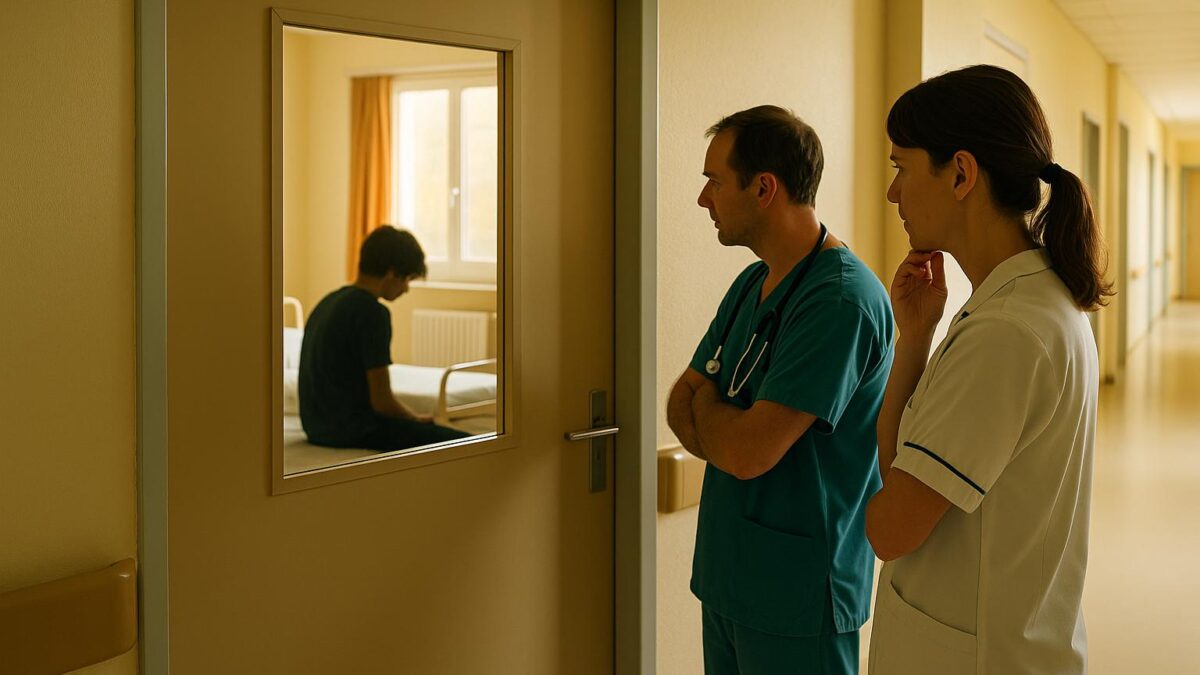
According to an Irdes analysis published in 2026, isolation and restraint practices vary greatly from one hospital to another, without always being explained by the state of health of the patients. A reality which raises major ethical questions and highlights the limits of a system under tension. This report comes shortly after a shock campaign by Autisme info Service aimed at breaking the silence on these practices.
Extreme practices, still widely used
Isolation and restraint remain exceptional measures in psychiatry. They consist of locking a patient alone in a dedicated room or restricting their movements, most often to prevent immediate danger.
On paper, their use is strictly regulated. In fact, their frequency continues to raise questions.
The Irdes study highlights a striking reality:
practices vary greatly from one establishment to anotherwithout these differences being able to be fully explained by the characteristics of the patients.
In other words, with a comparable profile, a patient could be isolated or contained in one hospital… and not in another. As the study points out: “the differences in the use of isolation and restraint between establishments appear significant and poorly explained by the observable characteristics of the patients..
Behind this sentence, a question loaded with meaning: does the response to the psychiatric crisis depend, in part, on the place where one is treated?
To understand these differences, we must delve into the very functioning of the establishments.
Gaps that also reflect the conditions of care
The disparities observed are not solely due to individual medical choices. They reflect structural realities. The organization of services, the available staff, the training of teams, but also the professional culture play a determining role.
In certain establishments, teams favor relational approaches, crisis defusing and human presence. In others, faced with significant tensions — lack of personnel, overload of services — the use of isolation or restraint may appear to be an immediate solution. The study thus evokes the influence of context: “These variations may reflect differences in organization, resources or professional practices..
Added to this is a reality that is often barely visible: the daily pressure of teams. Managing acute crisis situations, sometimes violent, in a constrained environment requires difficult trade-offs. But these trade-offs are not neutral for patients.
Because behind each measure of isolation or restraint, there is a lived experience — often traumatic. A sudden break in the bond, a loss of bearings, sometimes a feeling of abandonment or punishment.
From then on, the question is no longer just organizational. It becomes deeply ethical.
A profound questioning of practices
These results are part of a broader debate, in France and internationally, on the place of these practices in psychiatric care. For several years, health authorities have called for their reduction, or even their gradual elimination, in favor of alternative approaches. Because if isolation and restraint can, in certain cases, prevent immediate danger, they do not cure. They contain a crisis without addressing its causes.
The Irdes study thus invites us to question practices in depth. Not to designate those responsible, but to understand what, in the organization of care, leads to these discrepancies.
It also opens up an essential avenue: that of the transformation of professional practices, through training, sharing of experiences, and the development of alternatives.
An underlying conviction emerges: the quality of psychiatric care is not only measured by immediate safety, but also by the ability to preserve the patient’s dignity.
Relearning how to care without confining yourself
What this study reveals goes beyond the walls of psychiatric hospitals. It questions our collective relationship to madness, to crisis, to vulnerability. Accepting that practices vary greatly means recognizing that other ways of doing things exist. That certain establishments manage to limit these measures, without compromising security. This requires time, resources, collective reflection. But also a change of outlook. Because behind every closed door, there is a person. A patient in pain, often disoriented, sometimes terrified.
Reducing isolation and restraint is not just about improving indicators. It is to reaffirm an ambition: that of a psychiatry which treats without excluding, which protects without constraining, and which, above all, never forgets the humanity of those it welcomes.