
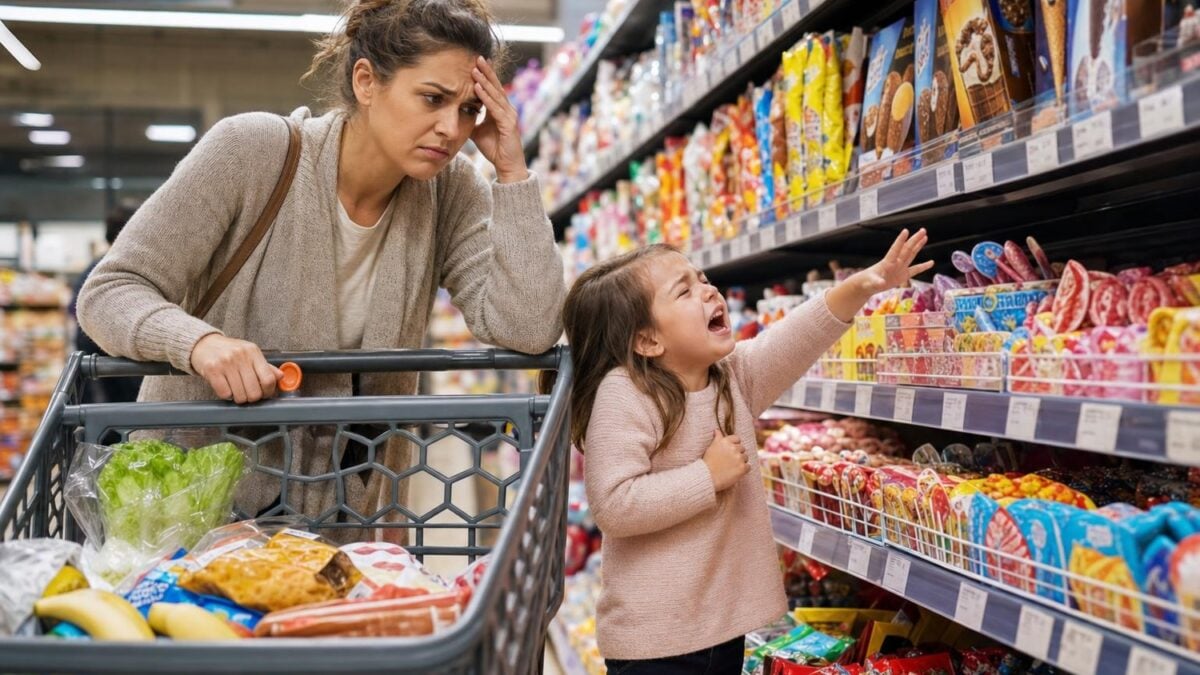
In England, supermarket aisles are often the scene of a discreet standoff between parents and children. A national survey of 1,050 parents, presented at the European Congress on Obesity (ECO 2026) in Istanbul, indicates that 58% of them are “often” or “always” harassed by their children or teenagers to buy products high in fat, salt and/or sugar (HFSS). In more than seven out of ten cases, parents end up putting the requested item in the shopping cart.
Behind these ordinary scenes lies a public health issue. Researchers from the University of Liverpool point out that one in three 11-year-old children in England are already overweight or obese when they leave primary school. For Professor Emma Boyland, specialist in food marketing and child health, “Even if children don’t foot the bill at checkout, their influence on their parents’ purchasing decisions is very real“According to her, it is above all the commercial and advertising environment which fuels this insistence, by hitting the most vulnerable families harder.
Survey in England: when pester power costs parents dearly
The study is based on an online survey carried out in September 2025 among 1,050 parents of children aged 1 to 18 in England, via the Savanta panel. In total, 58% of parents say their children “often” or “always” ask for products while shopping, and only 4% say this never happens. In 72% In some cases, adults admit to frequently purchasing the requested item, which leads 91% of them to spend more than planned.
Unplanned purchases follow the same logic. Among the parents surveyed, 59% cite in-store promotions and offers as the main driving force behind shopping, and 52% point to shopping with their child. Nearly a quarter (23%) say they come out of these sessions feeling sad, guilty or distressed.
What kids crave for junk food in England
The requests are mainly aimed at sweet products. Parents first cite ice cream and popsicles (45%), then candies and chocolates (43%), and finally biscuits and other sweets (42%). Children aged 4 to 11 make the most requests and are three times more insistent than toddlers aged 1 to 3.
“Children are very susceptible to aggressive and sophisticated marketing of unhealthy foods and drinks, and the frequent exposure we see encourages them to pester their parents, putting them at increased risk of overweight and obesity.”explains Dr Magdalena Muc, co-author of the study and researcher at the Open University (UK).
Parents describe a well-rehearsed arsenal: verbal requests for more than half of the children, whims for about one in five, direct placement of products in the shopping cart for one in three, and allusions to a display or an advertisement for about one in six.
Marketing, anti-junk food laws and inequality in England
It comes as England limits placement and promotions of products high in fat, salt and/or sugar (HFSS) and cuts advertising for junk food. Researchers find that parents food insecurity are more often harassed, while one in three 11-year-old children live with overweight or obesity.
According to Professor Boyland, “our results provide crucial new information on the magnitude, impact and modifiable factors influencing children’s dietary demands. This information should help inform the design and evaluation of public health policies aimed at protecting children from the relentless marketing of unhealthy foods and reducing childhood obesity and health inequalities.”.
Behind the whims on the shelves and the negotiations at the checkout, this study above all shows how marketing strategies targeting the youngest go well beyond the framework of simple pleasure purchases. For researchers, limiting children’s exposure to promotions and advertising for ultra-processed products could become an essential lever to curb childhood obesity… but also alleviate a daily pressure that many parents say they suffer in silence.