
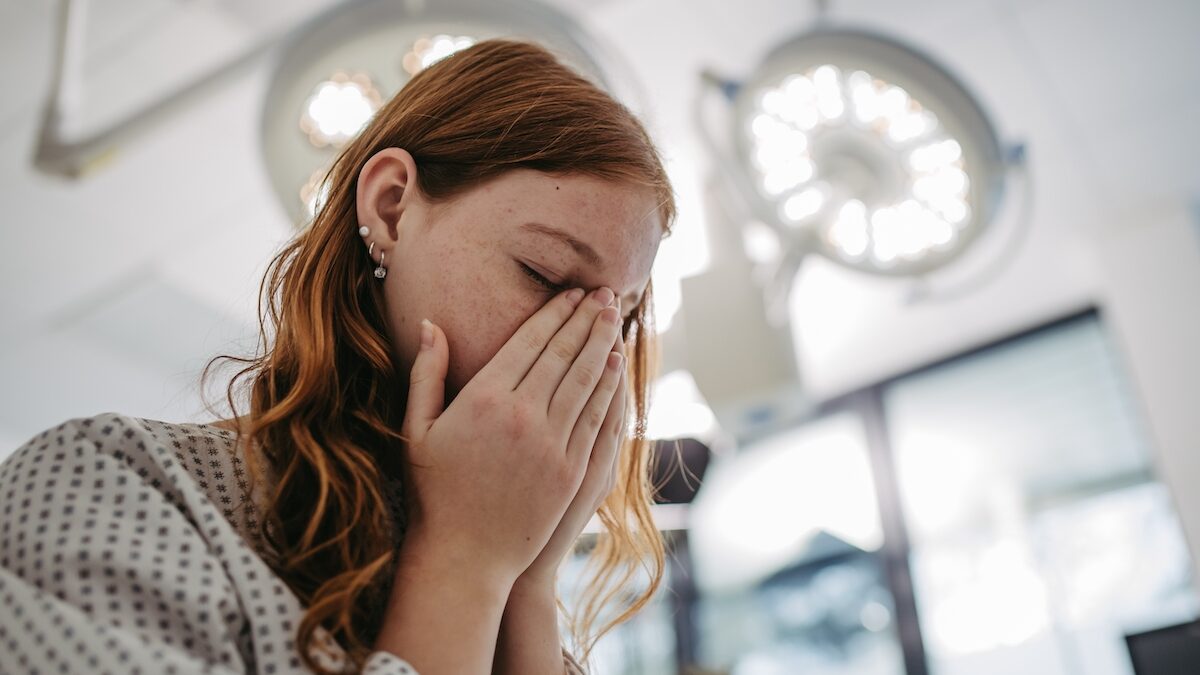
For years, Katie Birmingham searched for answers. At almost every medical appointment, we talked to him about stress, anxiety, and a functional digestive disorder. Now aged 21, the young American lives with a feeding tube and several serious chronic illnesses. Her journey illustrates a reality that is still common: physical symptoms wrongly attributed to psychological disorders… especially among women.
A disease that begins in childhood
From a young age, Katie didn’t feel like everyone else. She regularly suffers from stomach aches, often falls ill and feels constantly exhausted. In elementary school, she frequently had to leave class after lunch because of recurring abdominal pain.
When she consulted for the first time, the diagnosis quickly came: anxiety. Too young to question this explanation, she adapts and tries to live with these symptoms. But as he grew up, his condition did not improve. On the contrary.
Years of medical wandering
During adolescence, the pain becomes more intense and more frequent. Examinations reveal nothing abnormal. Doctors then evoke an irritable bowel syndrome… always associated with an anxious dimension.
In 2022, everything changes. Katie wakes up one morning with symptoms she thinks are gastroenteritis. But the days pass, then the weeks… and nothing disappears. His condition is gradually deteriorating. She suffers from dizziness, extreme fatigue, diffuse pain, palpitations. She can no longer follow a normal rhythm of life. Yet the medical responses remain the same.
“Most of my symptoms were downplayed or attributed to anxiety“, she confides.
The turning point in diagnosis
It was only in 2024, after a long medical journey and in-depth examinations in a specialized center, that a first diagnosis was finally made: postural orthostatic tachycardia syndrome, or PoTS.
In the process, other pathologies are identified, including hypermobile Ehlers-Danlos syndrome, connective tissue disease, as well as other associated disorders.
But the diagnosis comes late. In the meantime, his condition has deteriorated considerably. She is no longer able to eat properly. At the end of 2025, she must have surgery and will have a feeding tube inserted to bypass her digestive system.
When anxiety masks a real illness
Katie’s story is far from an isolated case. Many women report that their symptoms have been minimized or psychologized.
Dr Gérald Kierzek warns of this frequent confusion. “Postural orthostatic tachycardia syndrome is often confused with anxiety, especially in young women“, he explains.
However, there are objective elements which allow us to distinguish the two.
In the case of PoTS, the symptoms are based on a well-identified physiological mechanism. When the person goes from lying down to standing, their heart rate increases excessively, without a drop in blood pressure. This phenomenon can be measured and reproduced during specific examinations.
“A pathology like PoTS should be considered when symptoms persist despite anxiolytic treatment and are accompanied by measurable physical signs.“, specifies the doctor.
An invisible but disabling illness
PoTS affects the autonomic nervous system, the one that regulates essential functions like heart rate or blood pressure. It can cause discomfort, intense fatigue, cognitive disorders, pain or even nausea.
In some people, like Katie, it is associated with hypermobile Ehlers-Danlos syndrome. This genetic disease weakens tissues and disrupts the overall balance of the body.
Daily life then becomes a permanent challenge. Getting up, walking, eating, thinking… simple actions become tiring. But no one had seen all this.
Today, Katie lives with significant limitations. She can no longer lead a traditional social life and must adapt her daily life to her symptoms. What makes the situation even more difficult is the invisibility of the disease. Despite everything, she continues to create, draw and share her experience on social networks.
To be heard, finally
Her journey pushed her to become an actor in her own health. She had to search, understand, insist, sometimes against the advice of professionals.
“If people had listened to me from the start, I wouldn’t have needed to do so much research”she said.
She also denounces a medical approach that is sometimes too standardized. “We teach doctors to think about the most frequent cases. OK. But some patients are not ‘horses’, they are ‘zebras’.”
Better recognize these diseases
Today, there is no cure for PoTS or Ehlers-Danlos syndrome. Treatment is based on lifestyle adaptation, symptomatic treatments and specialized medical monitoring.
But beyond treatments, the main issue often remains diagnosis.
Katie’s story is a reminder of how crucial it is to listen to patients, not reduce everything to anxiety, and stay attentive to the body’s signals.
Because behind certain invisible symptoms, there is sometimes much more than simple stress.