
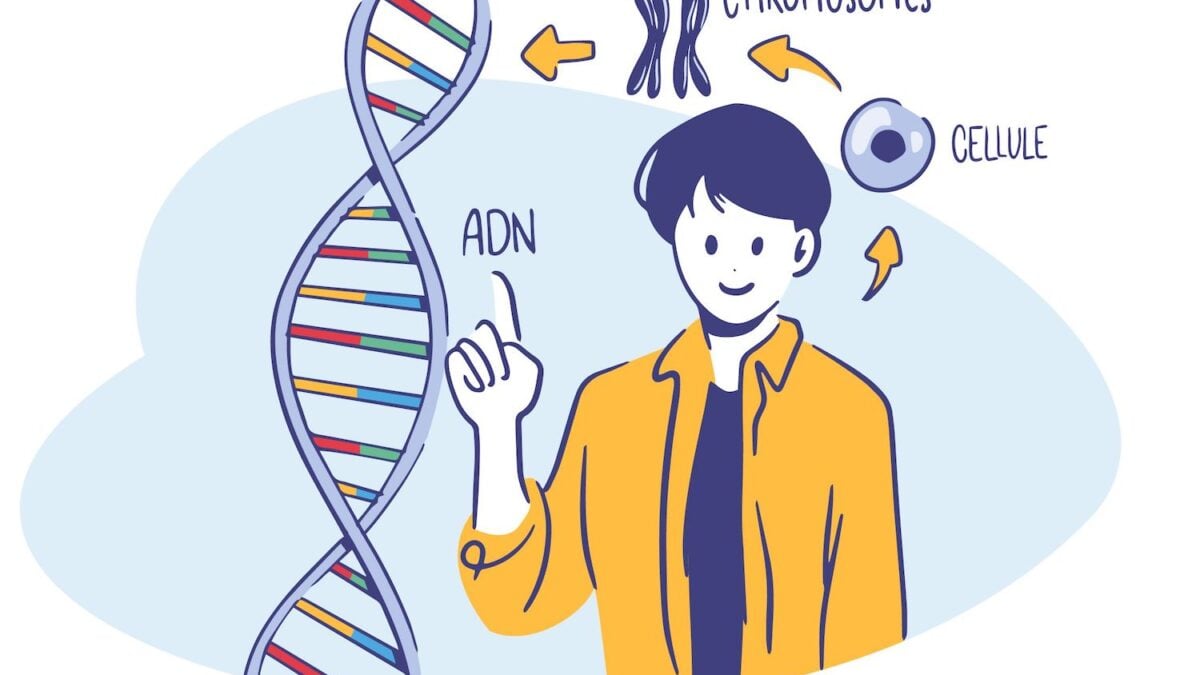
As genetic examinations multiply and scientific discoveries accelerate, the need for reliable, educational and human information becomes crucial. Because behind each result there is often much more than a diagnosis: a family history, an intimate concern, sometimes an entire projection of the future.
When genetics runs in families
Until a few years ago, medical genetics seemed to belong to a distant universe, almost reserved for laboratories and researchers. Today, it appears in consultations, maternity wards, cancer journeys, and the stories of families faced with a rare disease.
A word spoken by a doctor — “genetic abnormality,” “mutation,” “predisposition” — can suddenly throw a life into uncertainty. Understanding what a test means, knowing what it really reveals, measuring its consequences for yourself or your loved ones: for many patients, dizziness often begins there.
It is precisely this observation that led the Biomedicine Agency to completely rethink its information portal dedicated to medical genetics. In a press release published on May 11, 2026, the institution announced the launch of a new version of the genetic-medicale.fr site, with a clear ambition: to make this discipline more readable and more accessible to the general public.
 © Biomedicine Agency
The common thread of the site is a simple formula: “Genetics for all”. A promise that says a lot about current developments in medicine. Because genetics is no longer just a matter for specialists; it is gradually becoming a public health subject.
The portal now addresses “in priority to the general public, patients and their loved ones, as well as healthcare professionals”. A way of recognizing that medical information can no longer remain confined to expert circles when patients themselves must make decisions that sometimes have serious consequences.
Understanding without frightening: the immense challenge of genetic information
Talking about genetics is never neutral. Because it’s a question of heredity. Transmission. Of children to come. Diseases that sometimes cross several generations in silence and incomprehension.
For many families, genetic testing is filled with hope as well as fear. The hope, finally, of putting a name to unexplained symptoms. The fear, too, of discovering a predisposition or an anomaly of which no one yet knows exactly what it will imply in the future.
In this context, access to reliable information becomes essential. The Biomedicine Agency emphasizes this central issue:
“The objective of the Biomedicine Agency is to ensure that anyone seeking information on genetic tests or hereditary genetic diseases finds, first of all, reliable, neutral and serious information on this site.“
This precision is not trivial. Because as research on DNA progresses, the Internet has also been filled with approximate, anxiety-provoking or commercial content around genetic tests. Between hazardous popularization and excessive promises, patients can quickly find themselves alone when faced with contradictory information.
The new portal therefore attempts to structure this often labyrinthine route. The content is now organized around three main sections: “Genetic diseases”, “Medical genetics in France” and “Genetic examinations”. Behind this architecture lies a deeper desire: to support patients step by step, without brutality, in a field where every word counts.
The site thus covers the entire field of medical genetics: prenatal diagnosis, preimplantation diagnosis, post-mortem genetic examinations, incidental data and even the legal framework surrounding these practices.
In other words, it’s not just about explaining science. It is also necessary to explain ethical choices, medical limits, areas of uncertainty. Because modern genetics is advancing quickly. Very quickly. And sometimes even faster than our collective capacity to measure its human implications.
A medicine in the midst of a revolution, still riddled with questions
The site redesign comes at a pivotal moment for genomic medicine. Sequencing technologies now make it possible to analyze DNA with unprecedented speed and precision. Some rare diseases can be diagnosed earlier. Targeted treatments are emerging in oncology. Hereditary risks can be identified before symptoms appear.
But these advances also open up complex territories. What should you do when an examination reveals, by chance, a genetic anomaly unrelated to the disease being investigated? How can we psychologically support a patient faced with a predisposition of which he or she does not yet know whether it will one day manifest itself? How to protect genetic data, among the most intimate in existence?
The Biomedicine Agency portal intends precisely to support these new questions. The institution is already announcing the future arrival of dedicated content “to genomic medicine or incidental data“.
This desire for constant updating reflects a fundamental reality: medical genetics is not a fixed science. It advances through successive discoveries, sometimes spectacular, sometimes cautious, always complex.
The Agency also recalls its role in this delicate balance between scientific innovation, health safety and ethical reflection.
Ultimately, this is perhaps where one of the great challenges of contemporary medicine is being played out today: bringing extraordinarily sophisticated science into the daily lives of patients without reducing them to their genome. Because behind each genetic analysis, there is a person who seeks above all to understand what this information changes — for their body, for their family, for their future.
And in this fragile dialogue between science and humanity, the quality of the words becomes almost as essential as that of the discoveries themselves.