
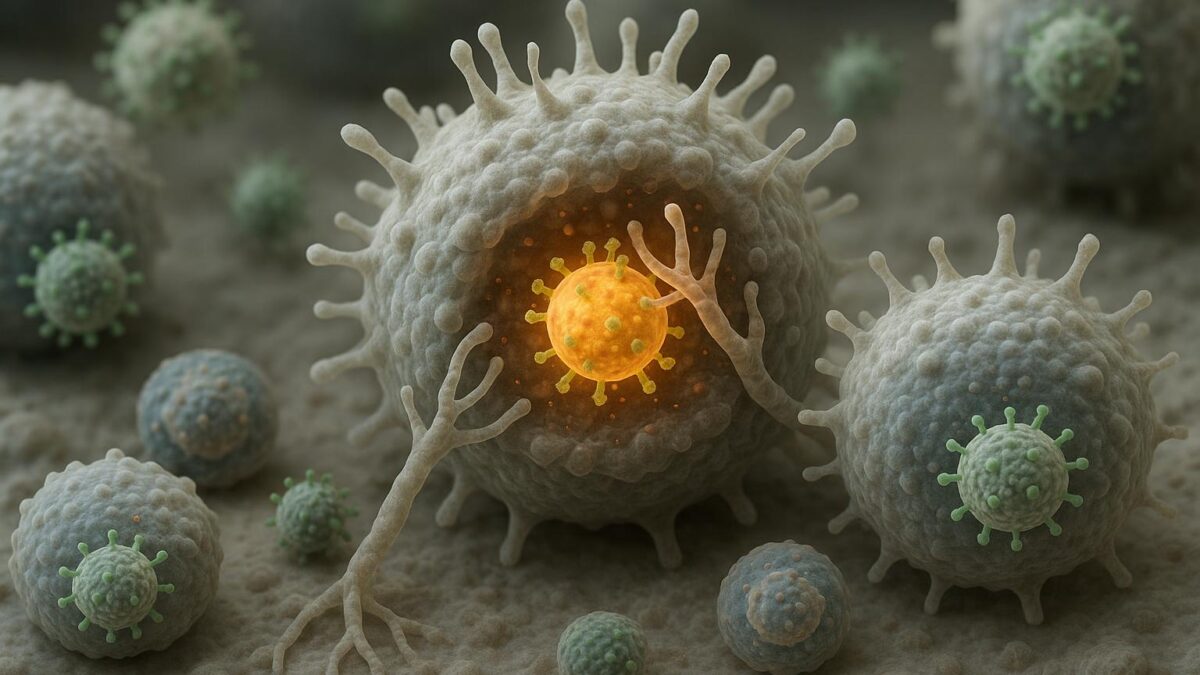
What if the “kissing disease” hid a much darker role? A team from Stanford University has just shown that a very common virus, responsible for infectious mononucleosis, could be the trigger of a serious autoimmune disease:
lupus. For decades, doctors have observed links between viral infections and disease outbreaks without understanding the underlying mechanism.
In the systemic lupus erythematosusthe immune system attacks the nuclei of the patient’s own cells, causing extreme fatigue, joint pain, skin rashes and sometimes kidney or heart damage. It is estimated that nearly 5 million people worldwide are affected, nine out of ten of whom are women. With proper diagnosis and treatment, most people with lupus can lead relatively normal lives, but for around 5% the disease can be life-threatening, said Professor William Robinson, professor of immunology and rheumatology.
The new study, published in the journal Science Translational Medicinedescribes for the first time how the Epstein-Barr virusan agent of mononucleosis, derails certain immune cells to the point of triggering this self-aggression. A scenario that changes the way we think about illness.
An almost universal mononucleosis virus
THE mononucleosis virusor Epstein-Barr virus, is most often caught through saliva, in childhood or adolescence. It can cause severe prolonged fatigue but sometimes goes unnoticed. By adulthood, more than 94 to 95% of humans have already been infected and keep the virus for life, lurking in their B cellswhite blood cells responsible for producing antibodies. “The only way to avoid the Epstein-Barr virus is to live in a bubble.”declared Professor Robinson. “If you have led a normal life, you have almost a 20 to 1 chance of being infected.”. Once a person is infected with the Epstein-Barr virus (EBV), it cannot be eliminated, even if no symptoms appear. EBV is part of a large family of viruses, including those that cause chickenpox and herpes, that have the ability to insert their genetic material into the nucleus of infected cells. The virus then remains dormant, escaping detection by the immune system. This latency phase can last as long as the host cell lives (including B lymphocytes that guard our immunity). However, under certain conditions, the virus can reactivate, causing the infected cell to produce many copies which can then infect other cells and spread to other individuals.
THE lupus corresponds to the failure of certain safeguards of immunity. Normally, some of the B lymphocytes produce antibodies directed against our own tissues but remain silent. In patients, autoreactive B lymphocytes, previously dormant, become activated, attack our own tissues and trigger one of the diseases grouped under the term autoimmunity. Some of these autoreactive B cells produce antibodies that bind to proteins and DNA inside the nucleus of our cells. These activated “antinuclear antibodies”, characteristic of lupus, cause tissue damage distributed randomly throughout the body, because almost all of the cells in our body have a nucleus with damage to the skin, joints, kidneys or brain. The outbreaks alternate with periods of calm, without us always knowing why.
“This study marks very important progress in the understanding of the disease“, underlined Alexis Mathian, quoted by Le Figaro.
How the Epstein-Barr virus derails immunity
To unravel this mystery, the Stanford team developed single-cell sequencing technology capable of identifying, one by one, B lymphocytes carrying the viral genome. In 11 lupus patients, the researchers found an average of 25 infected B cells per 10,000, compared to just 1 in 10,000 in 10 healthy controls. Above all, these infected cells were much more often autoreactive. “We believe this applies to 100% of lupus cases“, affirms William Robinson, who even declares: “This is the most significant discovery of my entire career in my laboratory“.
Analyzes show that the virus causes these particular B cells to produce a protein, EBNA2which acts as a gene switch. Under its effect, the cells take on the profile of true antigen-presenting cells: they display fragments of DNA or nuclear proteins on the surface, excite helper T lymphocytes then recruit other autoreactive B lymphocytes, sometimes uninfected. When this army of cells grows, a lupus flare-up results. In the end: a small population of infected B lymphocytes is then sufficient to trigger an autoimmune chain reaction throughout the body.
Consequences for patients and avenues for prevention
Robinson said he suspects that this cascade of self-targeted B cell activation generated by EBV may extend beyond lupus to other autoimmune diseases such as multiple sclerosis (for which Epstein Barr virus had previously been suspected), rheumatoid arthritis, and Crohn’s disease, where evidence of EBV-initiated EBNA2 activity has been observed. It remains to be seen why only a minority of us will develop lupus when 95% of us harbor the Epstein-Barr virus. Today we can only assume that a predisposition based on genes, hormones, other medical history…
This discovery is already fueling projects for anti-EBV vaccines and treatments targeting infected B cells, with the idea of preventing certain cases or curbing the disease more sustainably.