
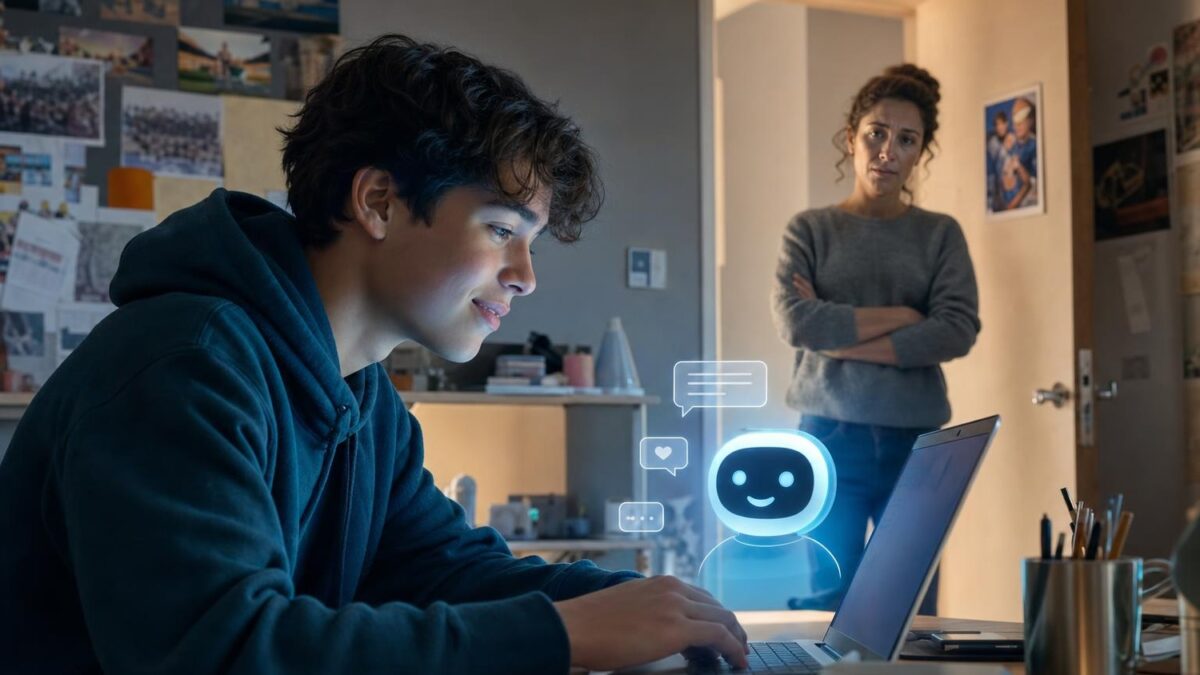
Parents already saw screens as a challenge; they now have to deal with generative AIs that respond, comfort and joke with their children. In 2025, Replika, Character.ai or assistants like ChatGPT establish a new intimacy between adolescents and software on a daily basis, noted by a reference interview published by Le Monde on April 26, 2025. For the psychiatrist and psychoanalyst Serge Tisseron, this is no longer a marginal question of technology, but the very heart of mental health in the coming decades.
He summarizes the issue with a formula: “The psychology of the 21st century will be that of interactions between humans and machines. Education must prepare young people for this,” he says in an interview with Le Monde. In the review of his work
A short treatise on cyberpsychologythe journal Carnet Psy cites a variant: “The psychology of the 21st century will be that of the relationships that men have with machines, or it will not be.” Understanding human-machine interactions then becomes as central as family conflicts have been for psychoanalysis.
A “psychology of the 21st century” centered on machines, according to Serge Tisseron
Serge Tisseron studies how digital objects transform emotions and social bonds; he co-hosts a university degree in cyberpsychology at Paris Cité University. This discipline is interested in what these machines “make us experience”: feeling of being understood by a generative AI, disappointment when a robot no longer responds. The machine becomes a psychic partner, sometimes ideal, sometimes worrying.
In The World, the psychiatrist recalls that this movement began in 1966 with Eliza, a program simulating a therapeutic interview, which had already aroused an unexpected attachment. Today, so-called companion chatbots function as commercial services designed to seduce and retain the user, not as “soul mates”. The illusion of a warm presence is based on artificial empathy, fueled by the personal data collected.
From companion chatbots to “toxic mother” AI: what risks for young people
This seduction particularly affects young people, familiar with imaginary companions and often looking to listen. In the work Kindergarten machinespresented in Le Point, Serge Tisseron goes so far as to assert that “AI is a kind of ‘toxic mother'”. Artificial intelligence reassures, compliments, never gets angry, but leaves the user dependent on its supposedly caring gaze, like a parent who stifles instead of helping them grow.
Asked by the Philonomist site about voice assistants, he believes that “Being polite to robots is confusing men and machines.” The risk is that the child no longer perceives the fragility of the other human, who may be injured, tired or in disagreement. When a teenager confides more easily in an AI that is always available than in those close to him, relational confusion sets in.
Why education must integrate the cyberpsychology of Serge Tisseron
Faced with this situation, the initial warning takes on its full meaning: education must prepare young people. The Avarap association describes artificial intelligence as a “Swiss army knife” which invades work, health, leisure, with ChatGPT, Copilot, Alexa or Siri. It warns of the loss of skills: if we delegate writing, synthesis or decisions too quickly to AI, human skills erode, especially among those who are still learning.
To respond, schools can integrate the relationship with machines into media education: explain that a generative AI has neither consciousness nor feelings, analyze a man-robot dialogue in class, discuss the data used. Teachers would need a foundation in cyberpsychology to identify problematic attachments and talk about them without dramatizing. The goal is to help children live with machines without abandoning what makes them human.