
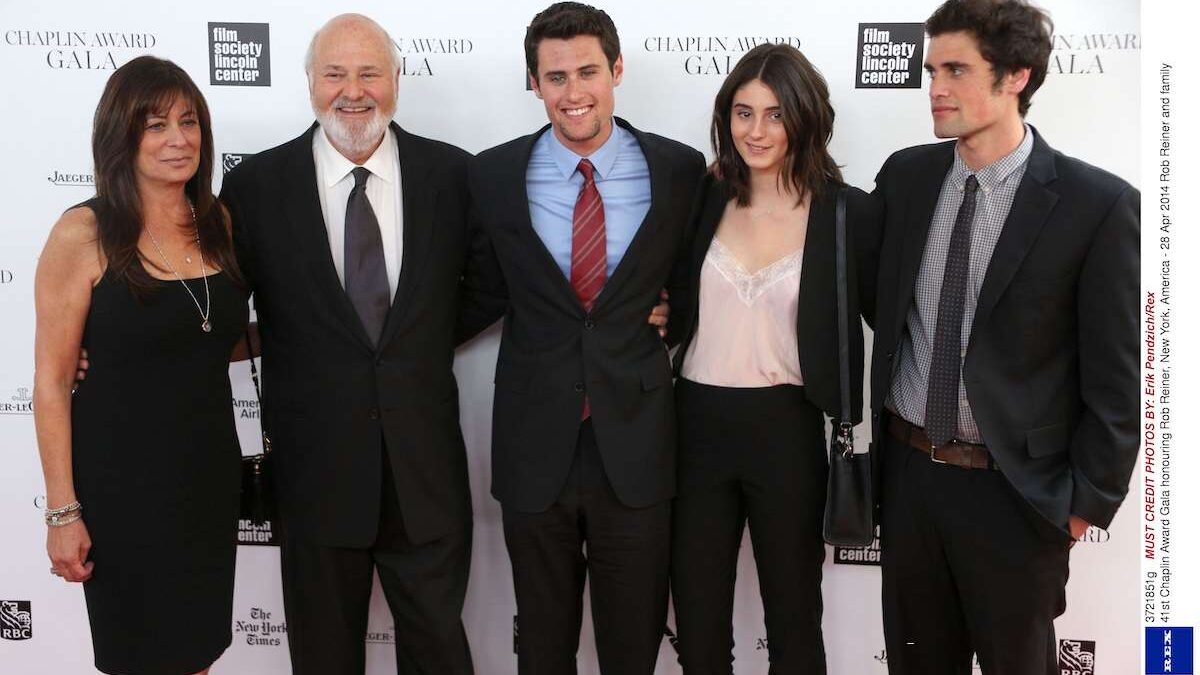
Drama in Los Angeles. On Sunday, December 14, director Rob Reiner and his wife were discovered dead in their home. A stabbing attack obviously provoked by their own 32-year-old son, Nick Reiner. Incarcerated, he should be charged with murder this Tuesday. But how does a son come to this hateful extremity?
What happened before the events?
According to those close to the family, the man had been through numerous trips to detox treatment since adolescence. A past as a young drug addict which gave rise to a film co-written with his father in 2015 “Being Charlie”. Close to his parents, Nick Reiner had returned to live at the family estate, but seemed once again to be gripped by drugs. There was talk these days of starting an 18th detox treatment.
Worried and not wanting to leave him alone, Rob and Michele Reiner insisted on Saturday evening that Nick accompany them to a Christmas party in the world of cinema. But in public, the thirty-year-old’s behavior leaves something to be desired, and is disturbing. The tone rises between father and son, an argument breaks out and the couple decides to leave the evening (with their son).
It was only at 4 a.m. that Nick Reiner checked into a hotel, stained with blood… The next day, an employee of the family found the door closed and warned the Reiners’ daughter. When she opens the home, Rob and Michele are found dead, victims of laceration and their throats slit. After a night of interrogation, Nick Reiner is charged with murder and his bail set at $4 million.
How can we explain such an act?
Nick Reiner would thus have committed the irreparable, parricide. An act that often affects mental health more than pure revenge. In France, parricides – that is to say the murder of one’s father or mother – remain rare and represent around 2 to 3% of homicides, according to the French Congress of Psychiatry. However, this proportion is four times higher among people suffering from psychiatric disorders. Among the crimes committed by these patients, almost a third are parricide.
Specialists also emphasize that the majority of adult perpetrators of parricide present with severe mental disorders: between 40 and 80% suffer from schizophrenia, and around a quarter suffer from depression, indicate psychiatrists.
To this is often added a “spark” which sets things on fire. For Johanna Rozenblum, clinical psychologist,”any criminal act involves a form of decompensation which may be linked to trauma”. The act cannot be carried out in adulthood.”as a result of psychotic decompensation, substance consumption or a new intra-family conflict. There must therefore be a triggering effect. An effect that will undoubtedly have to be explained during a trial.
Often complex and overlapping causes
For psychiatrist Joachim Mullner, contacted about the case of the Ménendez brothers, such a horrible act is also difficult to explain by a single, simple, clear cause. These are more often intricate and complex.
Among these causes of violent action there are some well-known ones:
- Alcohol consumption;
- Exposure, from a very young age, to violence, either against oneself or against loved ones, can also lead to a habituation of the brain or even a learning of violence as a suitable means of interacting with reality;
- A history of psychotrauma is found more among people who commit violence than in the general population;
- Precariousness is obviously also a strong source of antisocial behavior (which was not the case with the murderous brothers);
- Certain psychiatric disorders can also increase the risk of acting out, for example disorders causing disorganization of the brain’s processing of information with disorganization of thought, emotions and behavior;
- Finally, among the most serious criminals, we often find personality disorders, particularly of the sociopathic type, also called “psychopathic”.personality whose biological and social determinations are obviously intertwined, but whose biological weight can be suspected to be all the more significant as the disorders occur in early childhood (violence, cruelty, pleasure in seeing others suffer, etc.)”.
A monstrous act committed… by ordinary people
As terrible and shocking as this murder was, the psychiatrist nevertheless insisted on the complex nature of the perpetrators. “There is no discontinuity between “normal” people on one side and “monsters” on the other. It is a set of factors, determinants, causes, biological, psychological, educational, social, cultural, which mean that, little by little, a person can end up committing monstrous acts.”
It is therefore sometimes “no history” people, without any history of any disorder whatsoever, who can commit monstrous acts.
“It is also important to remember that these mentioned disorders lead first and foremost to a very increased risk of being victims of violence, but for the patients themselves,”
balances the psychiatrist. Attacking others (or one’s own family) is therefore much rarer.