
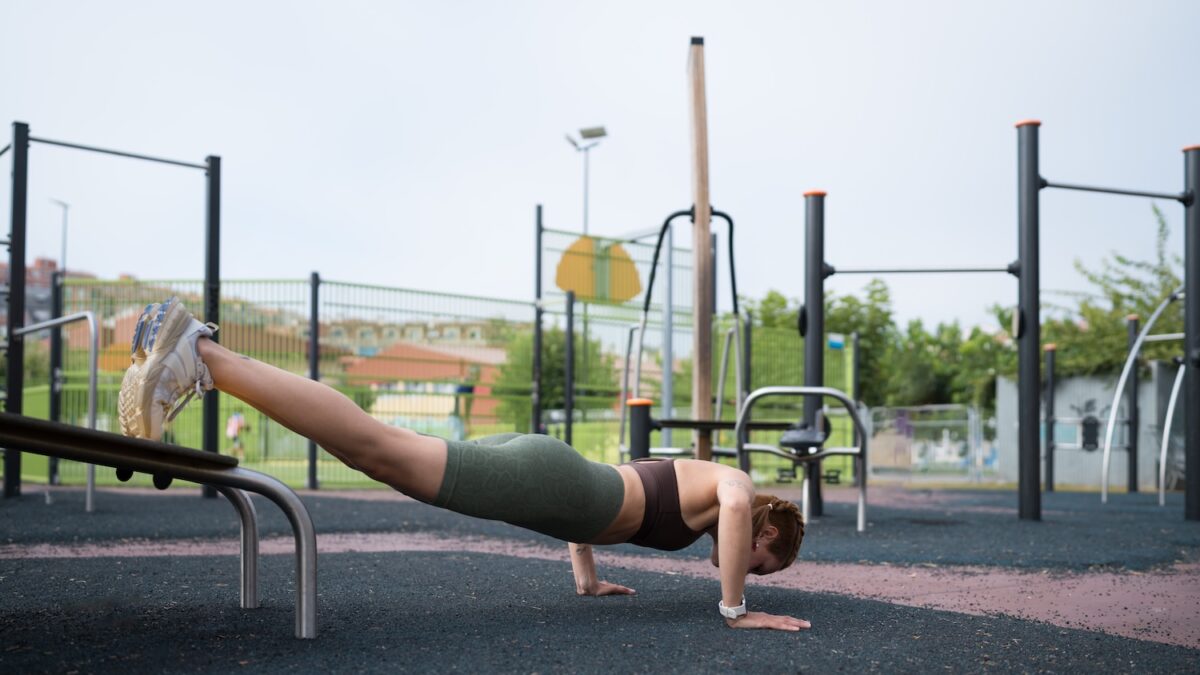
Push-ups, squats, core, pull-ups… Calisthenics seduces because it promises a complete bodyweight workoutwithout a gym or heavy equipment. The right entry point, however, is not the muscle-up or the flag seen on the networks, but the basics, worked on slowly and regularly.
Calisthenics is not just about spectacular figures
Calisthenics refers to a form of strengthening where the body serves as resistance. The Ministry of Sports describes street muscu, inspired by calisthenics and street workout, as a discipline which mobilizes muscle strengthening, flexibility and agility without complex machines or heavy loads.
In practice, there are movements that are simple to name but demanding to perform well: push-ups, squats, plank strength training, pull-ups, dips. Then come easier or more difficult variations depending on the level: push-ups on the knees, negative pull-ups, pistol squat, balance push-ups, one-arm pull-ups, handstand or front raise.
It is this discrepancy that often traps beginners: impressive figures are the culmination of learningnot the starting point. To begin calisthenics, it is best to consider each exercise as a technical skill. A well-controlled pump, with an appropriate amplitude and a stable core, provides more than a quick series where the shoulders, back or wrists compensate.
Why is it so attractive today?
Its first advantage is concrete: no need for a room or heavy equipment. A floor can be enough for squats, push-ups or cores; a wall can help certain exercises; a suitable bar opens the door to pull-ups and suspensions. This simplicity also makes it possible to train at home without equipment, or outside in a space designed for street workouts.
The practice also appeals because it is easily personalized. Everyone can choose a movement, a variation, a number of repetitions, a rest time, then gradually increase the difficulty. Depending on the exercises chosen, it can work on strength, core, balance, coordination and mobility. This does not make it superior in all circumstances to dumbbells or machines: the 2026 recommendations from the American College of Sports Medicine above all remind us that several forms of strengthening can be effective when they are regular, individualized and safe.
Social networks have amplified this visibility. The barre sequences, balances and static figures are tempting, but they often mask months, even years, of progress. The risk is not in liking these videos: it is in wanting to copy them too soon.
To start, slow down and simplify
The best benchmark is simple: a few well-controlled repetitions are better than a lot of poorly executed movements. At the beginning, you can dissect the gesture, visualize it, then execute it slowly. Three precise repetitions, with control and adapted amplitude, are more useful than ten repetitions done with strength or imbalance.
To build a solid foundation, group sessions around a few clear choices:
- Start with suitable push-ups, squats, core training and, if a reliable bar is available, easy pull-ups;
- Slow down the descent and ascent instead of seeking speed;
- Maintain a comfortable amplitude, without forcing a painful joint;
- Add difficulty only when the movement remains stable from start to finish;
- Plan recovery days, especially after a barre session or a new movement.
This logic is similar to that of progressive muscle strengthening: starting from what you have mastered, then gradually increasing the intensity. Progress matters more than visible performanceespecially the first weeks.
Body weight avoids heavy external loads, but
it does not eliminate the risk of injury. The shoulders, wrists, elbows or back can be heavily used, particularly on the bar, on dips or advanced figures. A bar must be stable, designed for this purpose and installed in a safe environment.
Health Insurance recommends resuming activity gradually and interrupting exercise in the event of
pain, discomfort or excessive fatigue. Medical or professional advice is preferable in the event of persistent pain, pregnancy, chronic illness, cardiovascular history, joint problem or resumption after a long period of sedentary lifestyle. This does not prevent you from starting: it especially helps to choose the right variation and the right rhythm.