

In Romania, a 26-year-old young woman felt uncomfortable… something was moving under her eyelid. After several days of discomfort, she went to the hospital for a check-up. But under the skin, doctors discover much more than just a foreign body.
An 11 cm worm undulated under his eyelid
Under the thin skin of his left eyelid, a long whitish filament seems to undulate, like a dancing vein. The doctors film the scene before delicately opening the eyelid: they extract an 11-centimeter white roundworm, very much alive.
This case, published in the New England Journal of Medicine
by Romanian doctors Gabriela Andreea Dumitru and Ruxandra Moroti Constantinescu, illustrates an infection as rare as it is disturbing: human heartworm disease.
How a dog’s parasite ended up in his eye
The worm identified, Dirofilaria repensusually infests dogs, foxes or wolves. It is transmitted by mosquitoes.
In dogs, the parasite grows, becomes an adult, then releases larvae into the blood. In humans, however, nothing goes as planned. Man is an accidental host: the larvae fail to develop to the reproductive stage and simply migrate into the body… sometimes as far as the eye.
In this specific case, the patient (who owned a dog) told the doctors that a small nodule had in fact appeared a month earlier on her right temple, before mysteriously disappearing.
A clear retrospective sign: the worm was slowly advancing under his skin, from the forehead towards the eyelid.
Fortunately, after extraction, the young woman did not suffer any complications. But the images and the story remain impressive, and remind us that certain zoonoses, although rare, do exist.
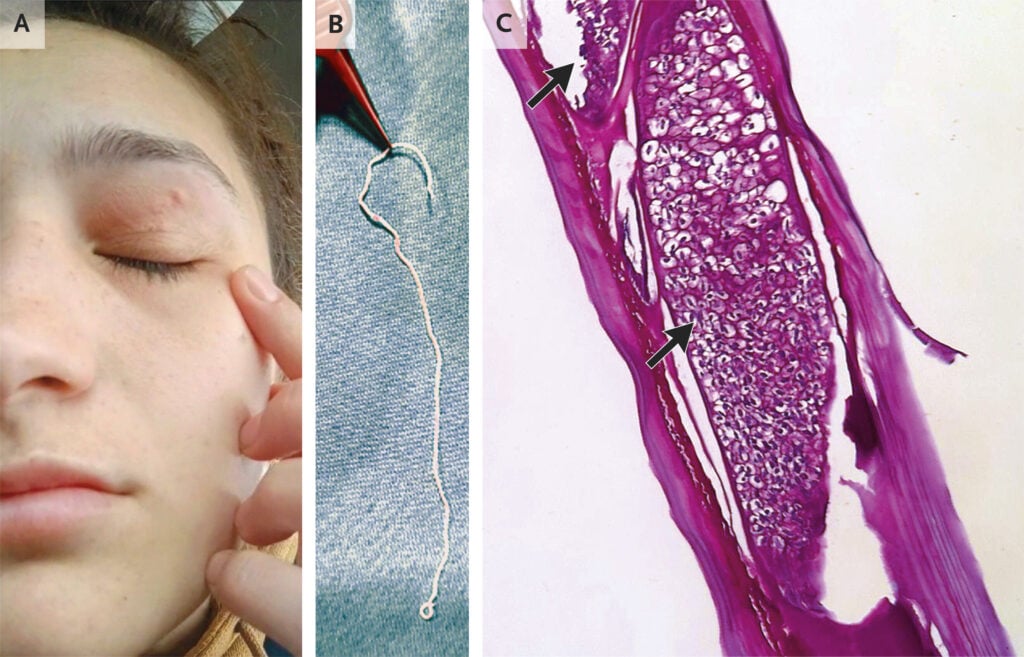 © NEJM
What human heartworm disease really is
Behind the spectacular side of the story, dirofilariasis “deserves to be better known”, recalls Dr Gérald Kierzek. Because this infection, although rare, is increasing in certain regions of Europe, due to climate change and the expansion of mosquito vectors.
“Human dirofilariasis is a rare zoonosis caused by nematodes transmitted by mosquitoes that have bitten an infected animal, mainly dogs”he confirms. “In humans, the parasite cannot fully develop: it is incapable of reaching the adult reproductive stage. But during its migration, it sometimes causes very confusing symptoms.”
The most common manifestation is pulmonary: often silent, it can nevertheless cause coughing, chest pain or a nodule on CT scan that can mimic… cancer.
Subcutaneous or ocular forms, like that of the young woman, are more spectacular: mobile nodules under the skin, swelling, pain, redness, foreign body sensation, even visual disturbances if the worm approaches the eyeball.
Extracting the worm, the only solution
The diagnosis is based on imaging (ultrasound, scanner, MRI), sometimes serology, but it is often confirmed after extraction of the parasite.
“In humans, the worm found is generally
dead or not fertilewhich confirms the accidental nature of the infection”specifies Dr. Kierzek.
Good news however: the generally surgical treatment is very effective. “Excision of the worm is sufficient, accompanied if necessary by anti-inflammatories or antibiotics in the event of secondary infection.
Unlike dogs, no systematic antiparasitic treatment is recommended, as it could cause an excessive inflammatory reaction.
A useful reminder: eye parasites exist!
The story of this young Romanian woman, as impressive as it is worrying, reminds us that certain parasitic diseases are not reserved for tropical regions. They can occur in Europe, in ordinary contexts, sometimes even without symptoms for several months.
Unexplained eyelid edema, a foreign body sensation, a migrating nodule, etc. should always lead to a consultation.
“Most of the time, it’s nothing serious — but in very rare cases, a parasite may be hiding there.” admits the emergency doctor.
To avoid unpleasant surprises, our expert advises respecting prevention principles, in particular, protection against mosquitoes.
- In endemic areas of Southern Europe;
- In Asia;
- And in areas where canine heartworm disease is common.
Repellents, mosquito nets, long clothing and regular antiparasitic treatment for dogs remain the best weapons. Because opening your eyes (and the right one) is not always enough.