

A large American epidemiological study suggests that your place among siblings leaves a discreet imprint on your health record. By analyzing, between 2003 and 2024, the files of more than 10 million people from 5.1 million families with two children, the researchers screened 569 categories of diseases. They identified 150 diagnoses whose frequency varied significantly depending on birth order.
Order of birth: what additional risks for the eldest and youngest
Published in the journal Nature Healththis work shows that the firstborns are more often diagnosed for neurodevelopmental disorders and allergic diseases, while second-born
present more diagnoses of dependence, migraines or digestive pathologies. Of the 418 diseases analyzed, 79 were found to be more frequent in the eldest and 71 in the youngest, an almost balanced distribution which surprised the authors. “Birth order is linked to disease risk more broadly than previously thought“, write the authors of the study.
In the Merative MarketScan cohort, seniors have increased odds of being diagnosed withautism (odds ratio 0.737 for the second born compared to the first), tics or Tourette syndrome, attention deficit hyperactivity disorder, food allergies and allergic rhinitis. This means that, among millions of children, these labels appear more often in the first one’s file than in the second one’s.
Cadets arrive more often with risks of dependence (substance use disorders), migraine, gastritis or duodenitis, bile duct disease and especially shingles (+35%). As co-author Andrey Rzhetsky of the University of Chicago summarizes, “we did not expect this result for shingles“.
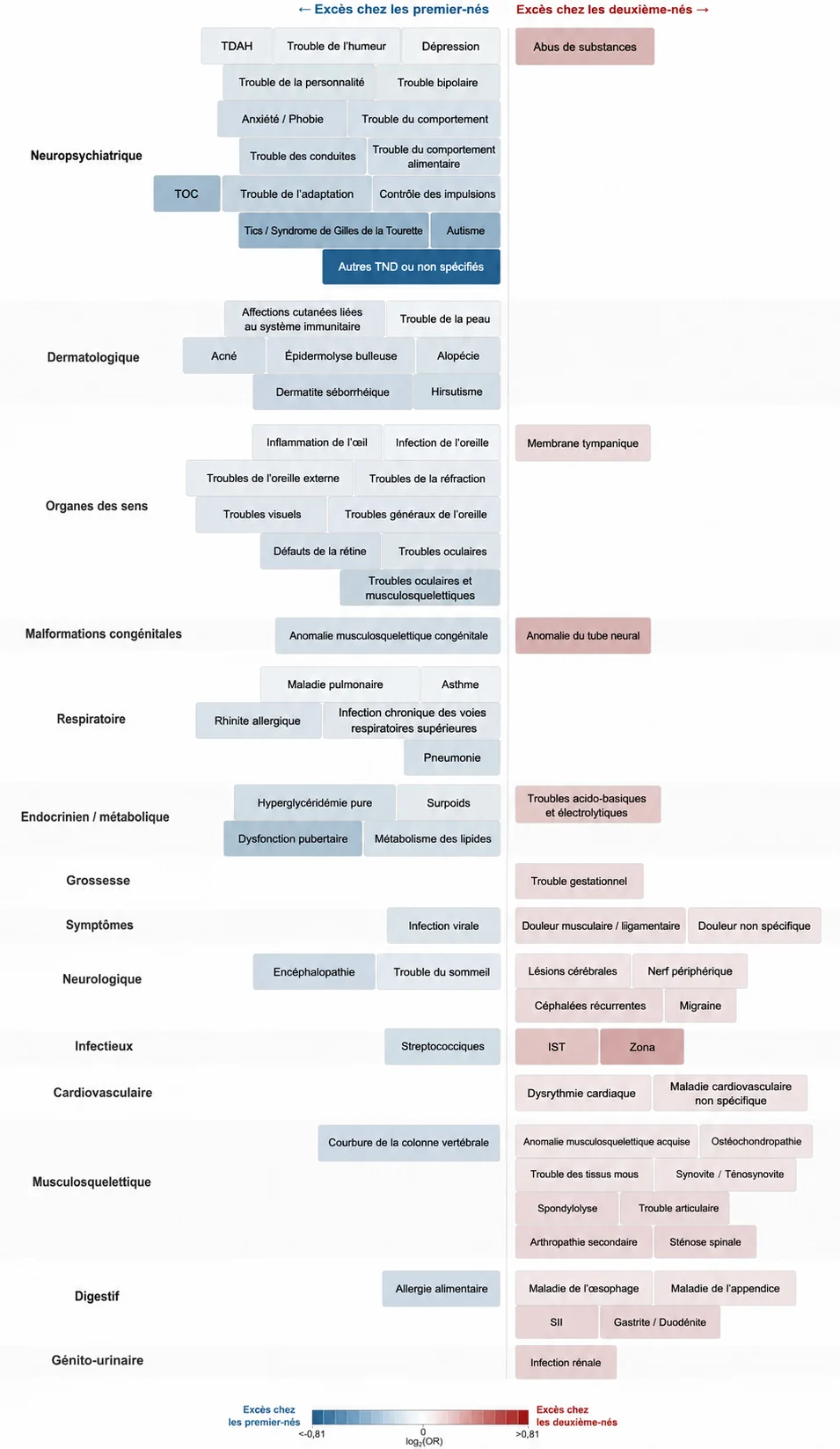 © Translated from Kramer et al., Nature Health (2026), CC BY-NC-ND 4.0.
Why does birth order influence certain diagnoses?
The authors put forward several avenues, without deciding. For allergies, they recall the so-called hygiene hypothesis: a younger child is exposed very early to the microbes reported by his elder, his immune system learns to tolerate more, and the risk of asthma or food allergies drops slightly. Conversely, parents tend to monitor a first baby more closely, which promotes earlier detection of autism or ADHD.
Risky behaviors, such as substance use, seem to be concentrated among younger people, possibly because they join the friend groups of their older brothers or sisters earlier. The team of Brenna Kramer, Samuel A. Kushner and Andrey Rzhetsky also notes that certain gaps decrease as the age between children increases, such as the excess of substance-related disorders among the youngest.
A useful signal for research, much less for each family
To limit family bias, the researchers compared both siblings and two children from the same family, rather than simple raw averages. They remind us that for a given family, theorder of birth
However, it remains a very modest factor, far behind background, lifestyle or access to care.
Behind a detail as trivial as birth order may hide an additional piece of the puzzle of our health. Without calling into question the much greater weight of genetics, lifestyle or environment, this work shows that the first years of life and the place occupied within siblings could also leave a discreet imprint. A promising line of research, but certainly not a tool for predicting the medical destiny of each child.