
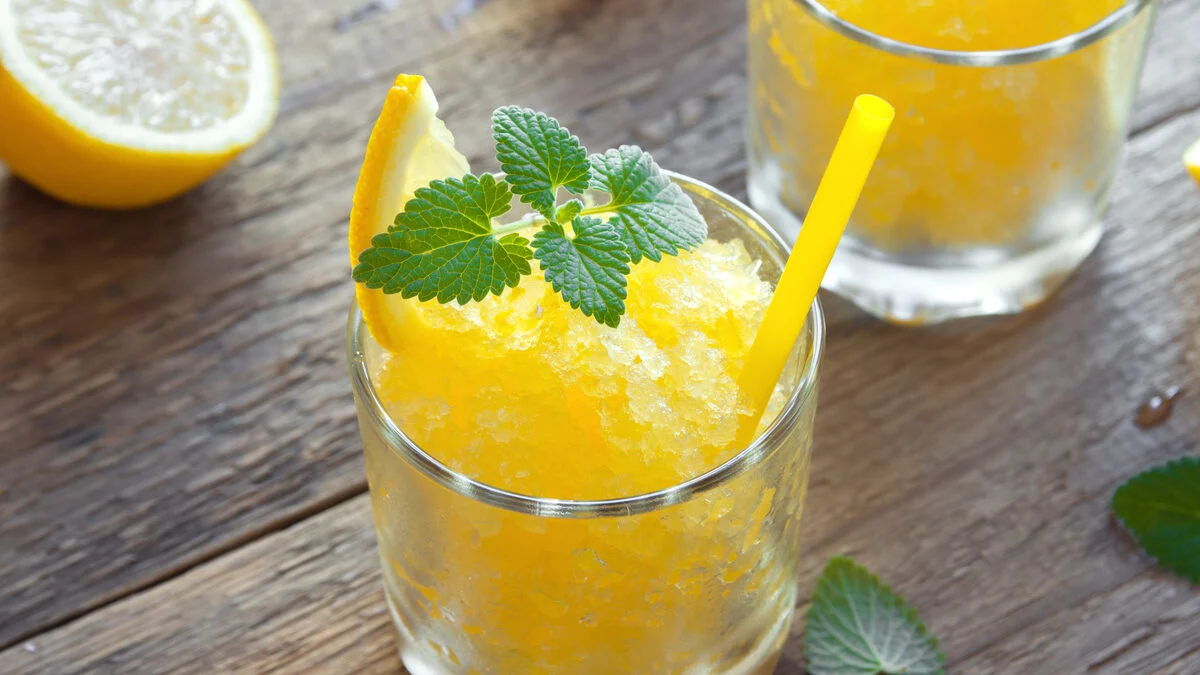
All over social media, we only see them: granita machines are creating a buzz and making us want to sip these frozen delights all day long. But if they allow you to control the ingredients used, cAre “homemade” granitas really good for your health? Pauline Pied, dietitian-nutritionist, answers us.
What is this famous granita made of?
A great summer classic, granita refers to this famous drink of Sicilian origin, which we enjoy at the beach, on the terrace and now at home. Particularly appreciated during hot weather, it is generally prepared from crushed or mixed ice, to which fruit, syrup or fruit juice (especially lemon juice) are added. The whole thing is then mixed in a large machine until it obtains a semi-frozen consistency, halfway between a drink and a dessert.
“It is generally composed of crushed ice, syrup and sometimes fruit. In any case, this is the basic principle of granita,” confirms Pauline Pied.
And if granita bought on the beach doesn’t really have a good reputation, what about versions prepared at home? Are they necessarily better for the body, as many contents published on social networks suggest? Not necessarily.
Be careful of excess sugar!
Not surprisingly, the homemade version of granita does not convince our expert.
“It remains prepared with syrup”, warns the dietitian. “If you regularly make it at home with a granita machine, my main advice would be simply not to be too heavy-handed with the syrup,”
she advises.
And if you prefer to use just crushed ice and fruit, then you’ll be closer… to a smoothie. “In this case, it is no longer really a granita, but another preparation”, specifies Pauline Pied.
In the end, if you want to stick with the classic granita recipe, but you are concerned about your health, there is only one solution available to you: moderate the quantity of syrup used. Also remember to vary the drinks consumed (low-sugar smoothies, iced teas, flavored waters, yogurt and fruit ice creams, etc.).
Granité: what is the right frequency to enjoy it?
As is often the case in nutrition, everything is above all a question of frequency and quantity. The idea is therefore not to eliminate this granita, but to enjoy it occasionally.
“It is also better to avoid drinking it repeatedly throughout the day. It is ultimately the same principle as for sugar in coffee: if you add two sugars to each cup and you drink ten coffees per day, the total quantity of sugar consumed quickly becomes significant. For granita, it is the same logic: the frequency counts as much as the quantity”,
concludes Pauline Pied.
A recommendation that also applies to many summer drinks, often presented as “light” and “vitamin-rich”. A useful reminder at a time when falsely healthy recipes are multiplying on social networks!
Granite bought on the beach, watch out for glycerol poisoning!
Glycerin, or glycerol (E422), is commonly used in granitas to maintain their characteristic semi-glazed texture. Without it, the drink would quickly turn into a simple block of ice. But if this additive is considered safe for adults in moderate quantities, the situation is quite different for children. Consumed in large quantities, glycerin could cause poisoning, causing headaches and nausea. And at very high levels of exposure—usually when multiple servings are consumed by a child in a short period of time—glycerol poisoning can cause shock, hypoglycemia, and loss of consciousness.
A study carried out in the United Kingdom and Ireland between 2009 and 2024 identified at least 21 cases of young children hospitalized after drinking slushes containing glycerol. In many of these situations, victims suffered nausea, severe headaches, metabolic acidosis and even in the most severe cases, profound hypoglycemia, which could lead to loss of consciousness.