

The Babinski reflex, also called Babinski sign, is a reflex observed during a neurological examination. It consists of a particular movement of the big toe when the sole of the foot is stimulated. This simple test is widely used by doctors to assess the functioning of the nervous system, particularly in infants but also in adults.
Although it may seem surprising, this reflex provides valuable insights into the maturation of the brain and spinal cord.
A reflex discovered by a French neurologist
Babinski sign owes its name to the French neurologist Joseph Babinski, who described this phenomenon at the end of the 19th century. In 1896, he showed that the reaction of the toes after stimulation of the sole of the foot could reveal damage to the central nervous system. This observation quickly became an essential part of the neurological examination.
Even today, this simple test is part of the examinations carried out by doctors to check the integrity of the nerve pathways which control movements.
How does Babinski sign manifest?
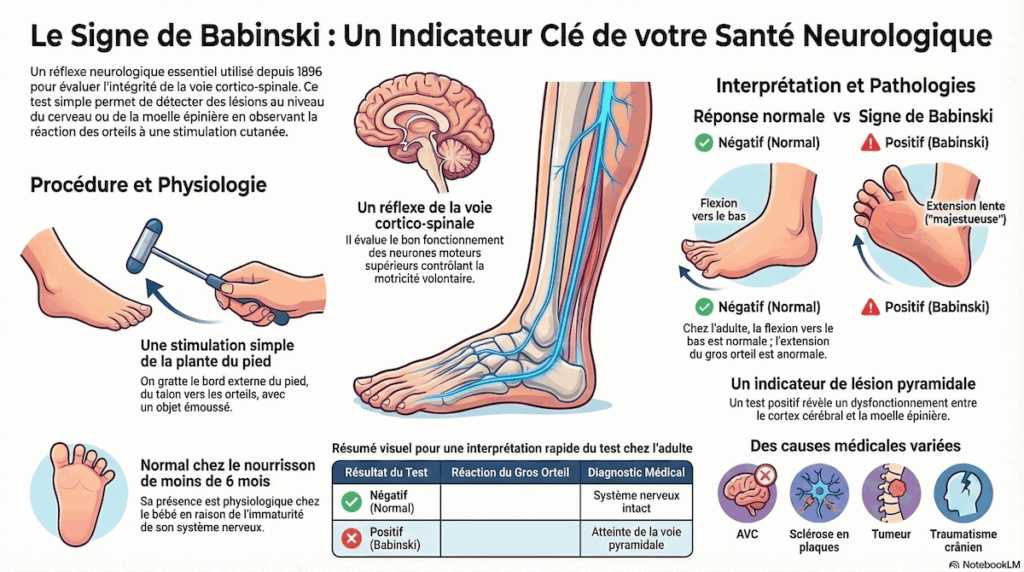
The test involves gently stimulating the sole of the foot with an object with a rounded tip (for example the handle of a reflex hammer). The doctor usually traces a movement from the heel to the toes along the outer edge of the foot.
Two reactions are then possible:
- Normal response (Babinski negative): toes curl downward.
- Positive response (Babinski sign): the big toe straightens upwards and the other toes can fan out.
In a healthy adult, toe flexion is the expected response.
Why is this reflex normal in babies?
In infants, the reaction is often different: the big toe straightens upwards. This is considered completely normal.
This response is explained by the immaturity of the nervous system. The nerve pathways that control voluntary movements — notably the corticospinal pathway, also called the pyramidal pathway — are not yet fully developed.
Over the months, the brain and spinal cord become structured, the nerve fibers myelinate (that is, they are covered with a sheath facilitating the transmission of nervous messages), and the reflex gradually evolves.
In general, this reflex disappears between 12 and 24 months, when the nervous system becomes more mature.
When does Babinski sign become abnormal?
In older children or adults, the presence of a Babinski sign may be an indicator of central nervous system damage. Specifically, it can reveal a disruption of the pyramidal pathway, a bundle of nerve fibers connecting the brain to the spinal cord and controlling voluntary movements.
In this context, the Babinski sign can appear in several situations:
- Cerebrovascular accident (CVA);
-
Multiple sclerosis;
- Brain or spinal cord tumors;
- Head trauma;
- Spinal cord injuries;
- Certain neurodegenerative diseases.
The sign may be present on one side or both sides, depending on the location of the neurological lesion.
A simple but important test
The Babinski test is quick and completely painless. It is part of the classic neurological examination carried out by doctors, particularly during a neurology consultation or in the emergency room.
If it is positive in an adult, it alone does not allow a diagnosis to be made. On the other hand, it can direct doctors towards additional examinations, such as a brain or spinal MRI, in order to find the origin of a possible neurological damage.
Key points to remember
- The Babinski reflex corresponds to the extension of the big toe when the sole of the foot is stimulated;
- It is normal in infants, because their nervous system is still immature;
- This reflex generally disappears before the age of 2;
- In adults, its presence can signal damage to the central nervous system;
- It is a simple but very useful tool for neurological diagnosis.
 © True Medical
Babinski reflex infographic
The Babinski sign is a simple but essential clinical test for understanding the functioning of the nervous system. Normal in babies, it gradually disappears with neurological maturation. In adults, its presence can constitute a valuable clue to detect certain neurological disorders, which explains why doctors continue to use it daily during clinical examinations.