
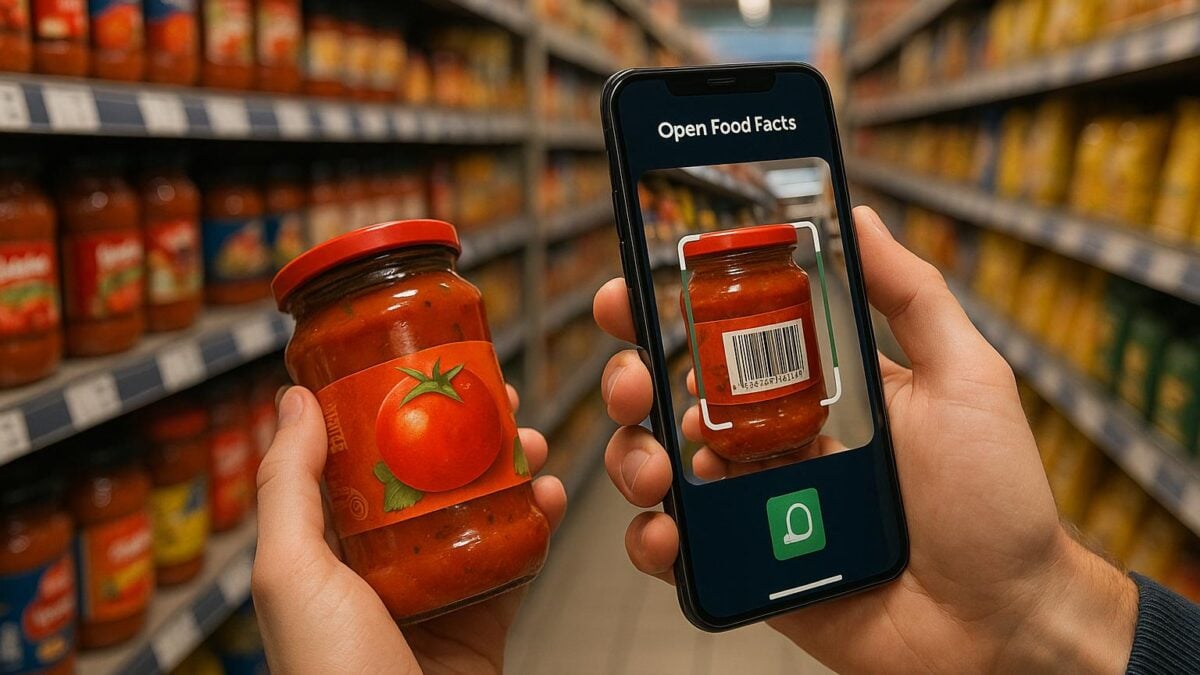
At the supermarket, the enigma repeats itself: very “clean” packaging, well-publicized promises, a sometimes long list of ingredients… Is it really a simple product or an ultra-processed trap that hides behind the health slogans? Ultra-processed foods take up massive space on shelves, while research is multiplying warning signs about their effects on health. Good news, there is a quick way to find out when you buy, without magnifying glass or complicated calculations. One gesture is enough.
Open Food Facts: the application that displays the NOVA group in one scan
Free on iOS and Android, the app Open Food Facts allows you to scan the barcode of a product and instantly display three key benchmarks: the Nutri-Score, the NOVA group (from 1 to 4) to locate the level of transformation, and theEco-Score. The app is based on a free database of more than 3.5 million productsdetails the additivesdetects the presence ofpalm oiland offers alerts for
allergens (open data, private scan history).
In practice, you scan, and the sheet immediately indicates “NOVA Group” : of NOVA 1 for raw or minimally processed products NOVA 4 for the ultraprocessed foods. This information complements the Nutri‑Score, because it provides information on processing, not just nutritional quality.
Ultraprocessed foods and the NOVA group: how to read the result
Classification NOVA evaluate the degree of processing food. It is “today the most used classification in numerous scientific studies, on which ANSES, but also the WHO or the FAO, base their expertise on ultra-processed food“, explains Foodwatch.
- NOVA 1 : raw or minimally processed foods (fruits, vegetables, legumes, rice, pasta, meat, fish, milk).
- NOVA 2 : processed culinary ingredients, such as butter, salt, sugar or oils.
- NOVA 3 : processed foods, for example canned fish, cheeses, breads; they contain two or three ingredients, and are made essentially by adding salt, oil, sugar.
- NOVA 4 : food
ultraprocessedoften formulated from substances derived from foods and additives for texture, taste and preservation, manufactured via several industrial processes.
Why be interested in it? Studies are accumulating on the risks associated with high consumption ofAUT. “scientific evidence is accumulating very quickly and massively to suggest a deleterious effect of ultra-processed foods on health“, supports Mathilde Touvier, according to 60 Million consumers. In France, the PNNS recommends reducing their share, and work cited by health authorities observes associations with type 2 diabetes, cardiovascular diseases, certain cancers, overweight and obesity. In 2024, a large study carried out among 10 million people had even linked the consumption of ultra-processed foods to 32 health problems: cancer, diabetes, cardiovascular diseases, sleep problems, depression…
In the United States, analysis of regimes using official databases suggests that 73% of calories consumed come from ultra-processed foods.
Alternatives and limits: Siga, Yuka, FoodProX and good reflexes
Open Food Facts displays the
NOVA classificationcomplementary to the Nutri‑Score. Other tools exist. The index
Siga (dedicated application) classifies the degree of transformation of 1 to 7 and takes into account both transformation,
additives and nutritional thresholds, to help limit the most processed products. Yuka, known to the general public, offers its own score, useful but different, because it does not display the NOVA group. The idea to remember:
transformation And nutritional quality are two dimensions to look at together.
Science is also advancing on the algorithm side. “As an individual, you can use this tool to identify which of the things you eat are highly processed and therefore help you seek out foods that are less processed.“, explains Albert-László Barabási, quoted by Hello Future. In daily use, keep a few simple guidelines from consumer tests: very long list of ingredientsof the
“barbarian” names such as maltodextrin or modified starches, claims such as “lightened” Or “rich in fiber” on sweet or fatty products, very colorful packaging targeting children, or
very low price are all possible signals of ultratransformation. And if a scanned product sheet appears incomplete, always check the ingredients on the packaging and choose the least processed version available.