
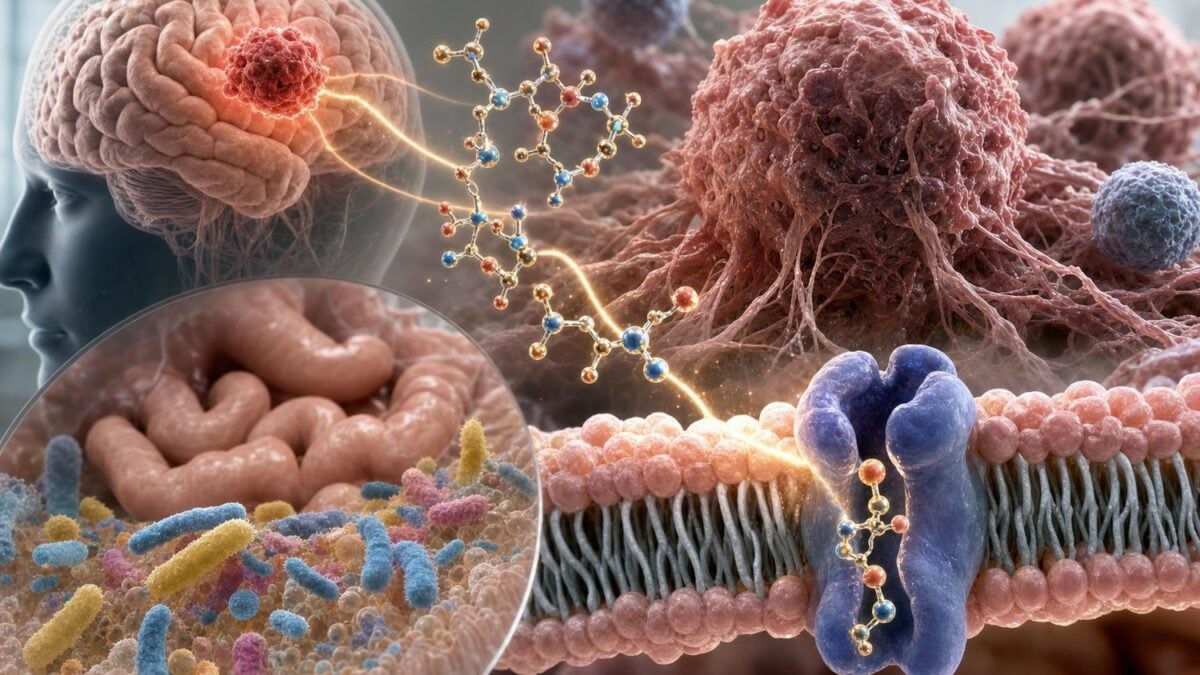
What if an almost unknown micronutrient influenced both our memory and the development of certain cancers? For more than thirty years, scientists have known that a small molecule from food and the microbiota plays an important role in how our cells read their genes. It remained to be understood how it entered the cells. An international team has just solved this enigma.
At the heart of this discovery is queuosine, a micronutrient that the human body is unable to produce. To benefit from it, it must therefore be obtained from food or recovered through its intestinal microbiota. The work directed by Valérie de Crécy-Lagard, at the University of Florida, and published in the journal Proceedings of the National Academy of Sciencesmade it possible to identify its transporter: the SLC35F2 gene. By combining these results with research on memory and tumor metabolism, scientists are highlighting an unprecedented link between nutrition, microbiota and personalized medicine.
Queuosine: a discreet micronutrient that influences memory and tumors
Queuosine is neither integrated into DNA nor directly into proteins. It is inserted into certain transfer RNAs (tRNAs), responsible for transporting amino acids such as histidine, tyrosine, aspartate or asparagine. It helps the ribosome to more precisely select the right amino acid. Result: fewer errors during protein manufacturing and a reduction in oxidative stress in the cell.
When this mechanism is disrupted, the consequences can be rapid. Work carried out at the German Cancer Research Center showed that the absence of queuosine modification in tRNA impairs contextual memory in female mice, while males appear much less affected. In the hippocampus, a region essential to memory, certain codons are less well translated, neuronal plasticity decreases and cognitive performance deteriorates. Remarkable fact: a simple dietary supplementation with queuine makes it possible to restore in a few days the capacities observed in memory tests.
SLC35F2: the transporter that reveals the importance of queuosine
For this “vitamin” to reach its cellular targets, it was necessary to identify its entry point.
“For more than 30 years, scientists suspected that there must be a transporter for this nutrient, but no one could identify it. We have been tracking it for a very long time”explains Valérie de Crécy-Lagard.
To solve this conundrum, his team combined comparative genomics and CRISPR gene editing approaches on HeLa cells. The researchers thus identified the SLC35F2 gene: when this is deleted, the absorption of queuosine ceases completely; when reintroduced, it resumes immediately. Experiments using radiolabeled molecules have also revealed a strong affinity for this micronutrient, with a Michaelis constant of approximately 174 nanomoles, with no other nucleosides appearing to be able to perform this function.
The researchers also localized SLC35F2 on the cell surface as well as in the Golgi apparatus. This observation suggests that queuosine follows cellular secretion pathways before being integrated into tRNAs. Notably, this gene was already known for its involvement in certain cancers, where it is associated with a poor prognosis. It also serves as a gateway for the anticancer drug YM155.
“We believe we would not have succeeded without the entire team”underlines Vincent Kelly, professor of biochemistry and immunology at Trinity College Dublin.
Microbiota, diet: what perspectives for medicine?
Produced by certain foods and by bacteria in the intestinal microbiota, queuosine could in the future become a biological marker of interest. In particular, researchers envisage that a simple blood measurement will make it possible to assess its level and guide personalized nutrition strategies.
“This discovery opens a whole new chapter for understanding how the microbiome and our diet can influence the translation of our genes”summarizes Vincent Kelly.
Ultimately, this advance could contribute to a better understanding of certain neurological disorders, but also to refine therapeutic approaches against certain cancers, taking into account diet, the microbiota and the genetic profile of patients.