
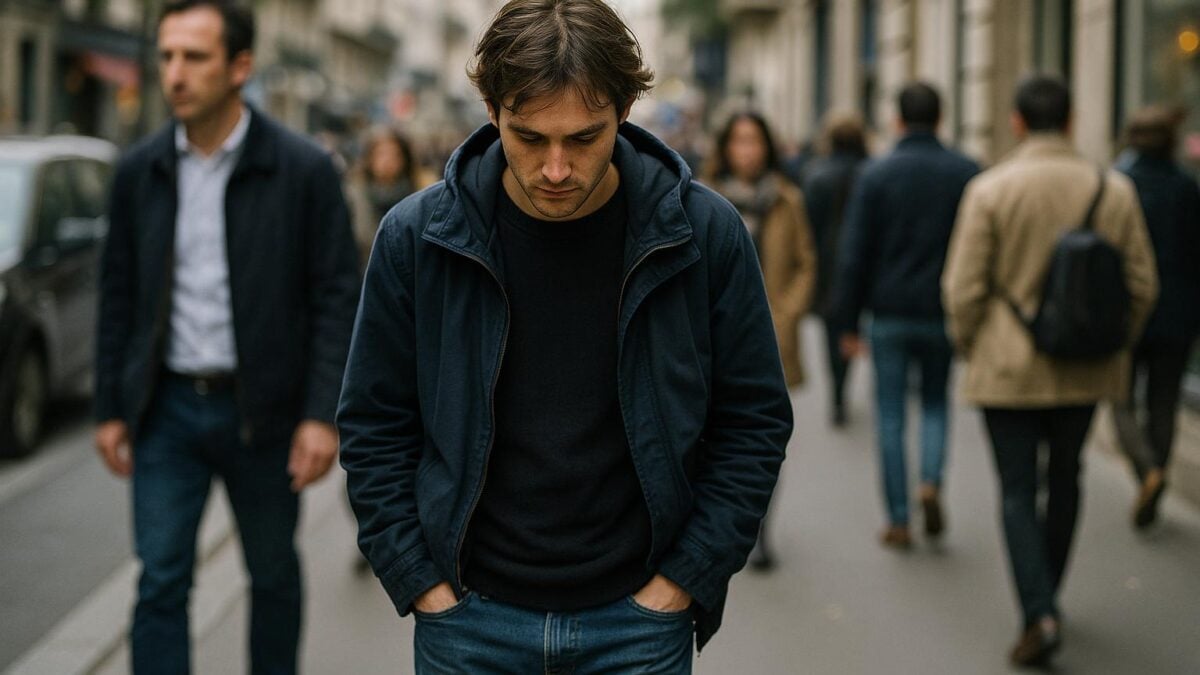
In the street, in the metro or at work, everyone has already noticed this person who walks with his eyes glued to the asphalt. We are quick to see shyness, or even a big drop in confidence, without really knowing why this detail appeals to us so much.
For psychologists and specialists in non-verbal languagethe way you walk is one of the most telling signals in everyday life. It tells something about the emotional state, the personality, sometimes even the level of inner fatigue. What if walk looking at the ground
ultimately said much more than what we imagine at first glance?
Walking while looking at the ground, body language that says a lot
Research in the human sciences reminds us that our way of walking is a strong non-verbal cue, just like the tone of voice or facial expressions. An upright posture, looking at the horizon, often signals confidence and availability to others, while a closed chest and eyes riveted to the ground more readily convey reserve and withdrawal. Some psychologists explain that this habit can go back to childhood, with marked shyness or a lack of self-esteem that has become ingrained in the body until it becomes a real signal of social avoidance.
- On a very concrete level, looking at the ground can simply serve to avoid tripping, particularly when the ground is uneven or considered unstable; researchers from the University of Rochester have observed that walkers spend more time staring at the surface when they fear a loss of balance;
- Work published in the scientific journal Scientific Reports also indicate that directing one’s gaze towards the walking area modifies the visual flow and helps the brain to stabilize posture, while reducing the activity of the prefrontal cortex, which goes in the direction of more automatic control of balance;
- In other situations, lowering your eyes serves to temporarily cut yourself off from external stimulation considered too invasive: noise, crowds, social requests, advertising, screens, everything that already overloads a tired mind;
- And then there is the telephone today: many passers-by walk while looking at their screen, which amounts, for the body, to staring at the area located just in front of the feet, without this necessarily reflecting a particular emotional state.
Shyness, anxiety or sadness, what walking with your head down reveals
When purely practical reasons or reasons linked to balance are not enough to explain this posture, psychology describes several frequent profiles. Walking with your head down can be a sign of great discretionor even a desire to blend in with the crowd: the person seeks to avoid eye contact, not to be noticed, especially in places of passage such as transport or company corridors. “On public transport or at work, moving with your head down means you know your way and don’t want contact“, analyzes Olga Ciesco, body language specialist cited by Psychologies. This gesture then becomes a sort of silent barrier which discourages exchanges.
For others, the gaze fixed on the ground is closer to a
defense mechanism. According to a study, people suffering fromsocial anxiety tend to avoid the gaze of others and often look down when walking, to protect themselves from fear of judgment. This reflex also appears after an emotional shock or during periods of strong sadness: the head lowered, the shoulders drawn in, the heavy steps then reflect a real inner withdrawal, as if the body were carrying the weight of worries. “Lowering the head reflects a person’s emotional state; they wish to withdraw at that moment.“, adds Aude Roy, synergologist and author of the book Give a good image of yourself. At these times, walking becomes quieter, more hesitant, and sometimes limits opportunities for social interactions, which can fuel a circle of isolation.
When walking with your gaze down should alert you, and when it is just a habit
However, psychologists insist on one point: you cannot make a diagnosis solely on the basis of a gait or a downward glance. For many people, it’s a habit built into their style, a way to focus on their thoughts, or a cultural way of showing respect and modesty by avoiding direct gaze. In some parts of the world, lowering your eyes in front of an older person or in a position of authority is even seen as basic politeness, while in Western contexts, this same gesture is sometimes interpreted as a lack of interest or self-confidence.
Rather, it is the frequency of this behavior and the signals that accompany it that will attract the attention of specialists. Several specialists mention the need to consult when the fact of walk with your gaze down becomes almost constant and adds to other signs of unhappiness. Situations that often come up are:
- A persistent anxietywith marked avoidance of gaze and interactions, to the point of limiting outings, journeys or social life;
- A lasting sadnessa loss of interest in usual activities, associated with slowed, hunched walking, and emotional fatigue that does not go away;
- A social isolation increasing, where the person withdraws, speaks less, and seems to constantly try to hide behind this gaze towards the ground;
- Of the sudden changes in mood or behavior, with irritability, sleep or appetite problems, which develop over time.
In these cases, several experts recommend opening a space to talk, without judgment, to allow the person to put into words what they are experiencing, and, if necessary, to refer them to a mental health professional. Observe someone walk with your eyes glued to the ground can then become one clue among others, a discreet signal which above all invites more listening and kindness, rather than sticking a definitive label on one’s internal state.