
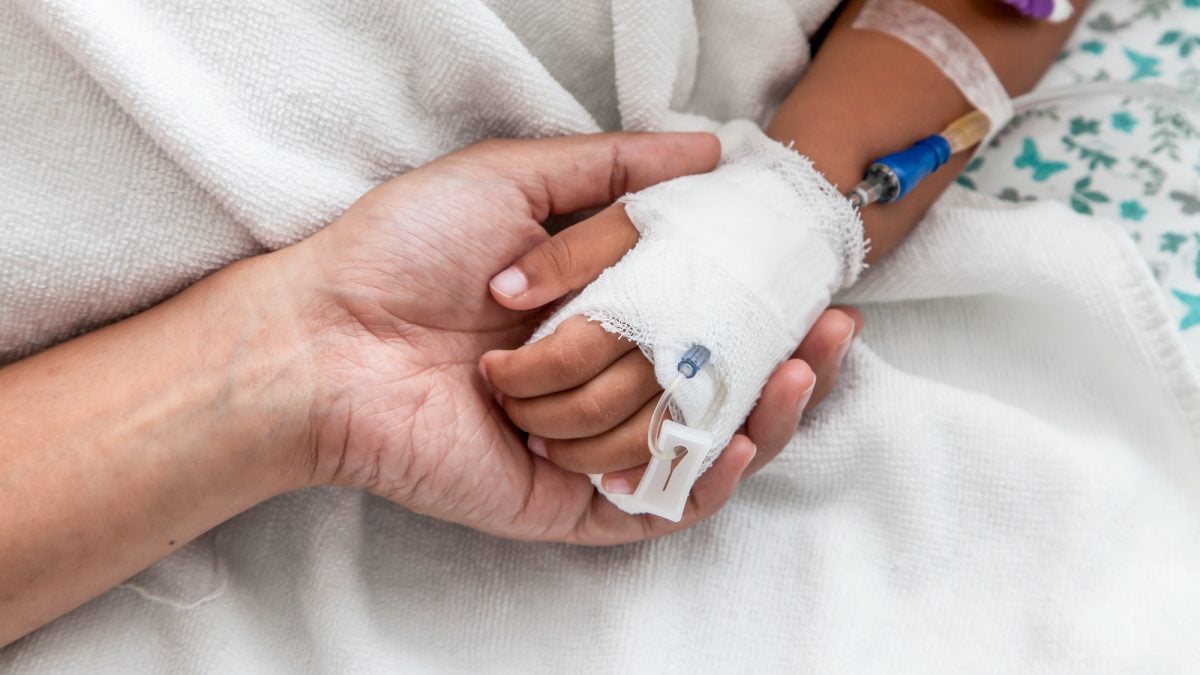
A tragic story that must serve as a reminder. On April 10, little Penelope, a 10 -year -old Briton, is going to complain of complaining that she was not very good. Nothing worrying: a little fatigue, a few nausea, and she joins her bed as usual. But around 2 a.m., she wakes up and vomited. Her father, Ricardo, decides to give her a bath to relieve her. Then go up it.
In the morning, Penelope does not feel better. It was then that his parents saw a purple mark on his leg, and another appeared in his neck. They then practice the “glass test”, a first aid gesture to detect meningitis. At Pénélope, the rash persists. The little girl was immediately taken to Ormskirk hospital, then transferred to the pediatric hospital Alder Hey, in Liverpool. The diagnosis falls: it suffers from a meningococcemie.
99 days of anxiety, then the amputation
His condition is suddenly deteriorates. In addition to meningitis, Penelope develops a rare fungal infection. Transferred to intensive care, it endures 99 days of major treatments, interventions and complications. Doctors have no choice but to practice a triple amputation: she loses her two legs and her right arm. A heartbreaking test, but which saves his life.
Purpura Fulminans: an absolute medical emergency
Behind a simple purple spot can indeed hide a danger of death. “”THE Purpura Fulminans is one of the most serious forms of meningococcal infection. It evolves in a few hours towards a Lightning septicemiaa generalized blood infection. Without immediate care, it causes amputationsa organ failure… even death ” explains Dr Gérald Kierzek, emergency artist and medical director of True Medical
This type of purpura is not a banal symptom. He announces critical condition. This is why every minute counts.
A sign to know: the stain that does not disappear
The peculiarity of purpura fulminans is visible to the naked eye: small red or purple spots which do not fade under pressure. “The glass test is simple and can save a life. Just press a transparent glass against the stain.” Recalls the emergency room:
- If it disappears under pressure, it is unlikely that it is a sepsis;
- If it remains visible, immediately call the SAMU (15): it is a vital emergency.
Alert signs never ignore
Apart from Purpura, several serious symptoms can announce a meningococcal infection. They vary according to age:
In children and adults:
- Very high fever (often> 39 ° C);
- Violent headache;
- Stiff neck;
- Vomiting in jet;
- Embarrassment in light (photophobia);
- Confusion, unusual drowsiness;
- Red or purplish spots that do not whiten with the glass test.
In infants (<1 year):
- Abnormally low fever or temperature;
- Groans, acute cries;
- Refusal to eat or drink;
- Curved fontanel;
- Gray, marbled complexion;
- Purple spots.
Faced with one of these symptoms: do not give a medication, and immediately contact the SAMU.
Only one means of prevention: vaccination
Finally, let us recall that since January 1, 2025, vaccination against meningococci has been compulsory in infants:
For babies:
- Méningococcus B (BEXSERO®) : 3 months, 5 months, recall at 12 months
- ACWY (NIMENRIX) meningococcus : 6 months, recall at 12 months
This vaccination is required for any community entry (crèche, school).
For older children: a single dose recommended between 11 and 14 years old, even if another vaccine was received before. For the 15–24 year olds not yet vaccinated, a catch -up dose is also recommended.
Finally last important detail according to our emergency artist “Never give ibuprofen or aspirin in the event of suspicion of infection – this can worsen the situation.”
Unexpected force in the affected girl
For his part, despite the shock, Penelope has shown since extraordinary resilience. Today she begins a long rehabilitation, strengthens her left arm, learns to move in a wheelchair, and keeps her energy. His father Ricardo testifies to a “Tourbillon of emotions, sorrow and anxiety”but above all expresses his gratitude to the medical teams who have “Save the life of (their) little girl”. A rescue that they also owe to their responsiveness.