
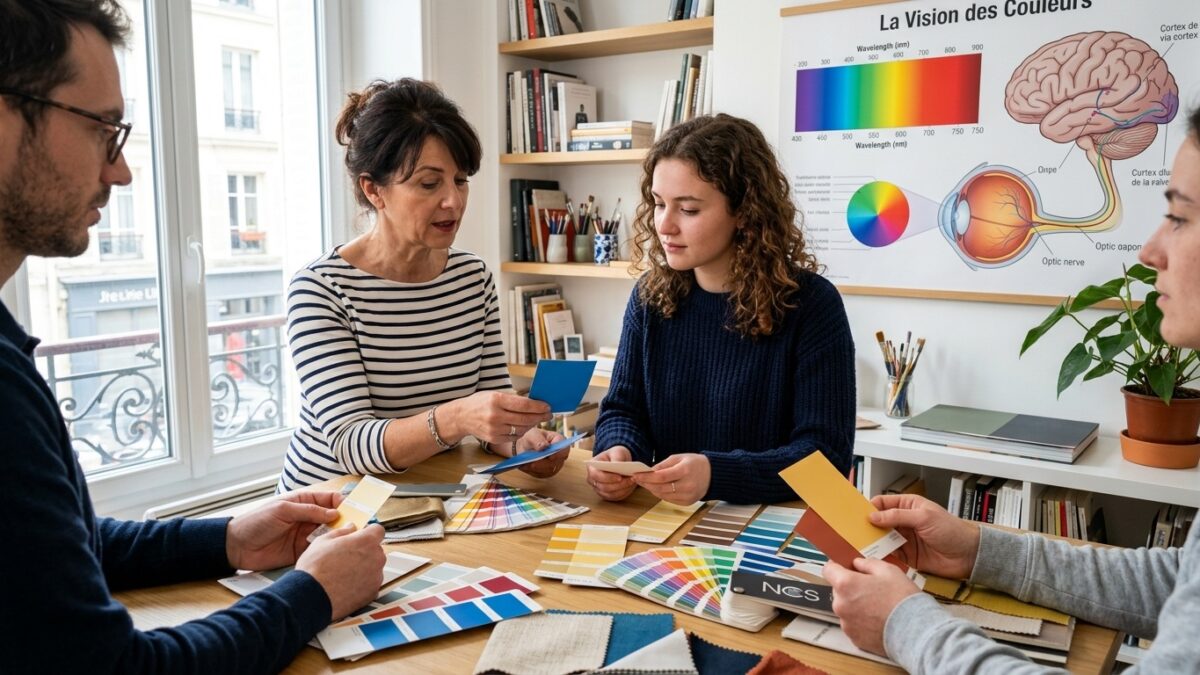
Is your green really the same as that of your friend, your partner, your neighbor? When you ask a group of people to choose “the” perfect green from a row of color charts, the answers go in all directions. However, everyone is convinced that they see color as it is.
Between different lighting, changing backgrounds and famous illusions, the same red apple can suddenly appear brownish, greenish, or even bluish. Behind this very subjective experience, however, lies a common base, physical and biological, which raises an old question: are colors universal or only in our heads?
Color perception: why our eyes don’t all see the same thing
The philosophers authors of the work “The Metaphysics of Colors” point out that a simple “single green” test already gives very scattered answers. The background also plays a key role: a gray placed on a light wall appears darker than the same gray on a dark background. This simultaneous play of contrast is enough to deceive a perfectly healthy eye.
Another pitfall is metamerism: two lights with different spectrums can appear to be the same color under a given light, then become distinguishable as soon as the lamp changes. A bit like water that one finds cold and the other lukewarm, without its temperature varying, the appearance of a hue can move without the color of the object actually changing.
What remains universal: visible spectrum, trichromy and color laws
Despite these variations, the human species shares the same basis: a visible spectrum of approximately 380 to 750 nanometers and so-called trichromatic vision. Three types of cones (S, M, L) respond to different areas of the spectrum. Since Grassmann and Maxwell in the 19th century, we have known that almost any color sensation can be reconstructed by combining three primaries, which gives a common mathematical language to colors.
This base allows colorimetry to announce in advance how mixed pigments or two matching fabrics will behave. For one can of paint to be declared identical to another, no observer, under any reasonable light, must see any difference. Hilary Putnam and Willard van Orman Quine have called the “indispensability argument” the idea that if science needs color to explain aposematism or animal vision, it is because it treats color as an objective reality.
Between brain, languages and species: how universal are colors really?
The brain divides this continuum into categories which vary. In French, we commonly speak of 11 major chromatic fields (red, blue, green, etc.), where other languages have fewer. In one test, the same shade was only described as “sky blue” by around 17% of respondents. The work of Paul Kay or Hering’s theory, taken up by Michel Pastoureau, nevertheless evokes cores of basic colors which recur almost everywhere.
The famous Sapir-Whorf hypothesis asks whether these words shape perception or the other way around. Meanwhile, other species still live in other colorful worlds. Some use UV signals that are invisible to us, like fish with facial patterns that only their peers see, while their predators cannot access them. In this landscape, the idea of a “normal” observer becomes above all a practical convention for comparing our very different experiences.