
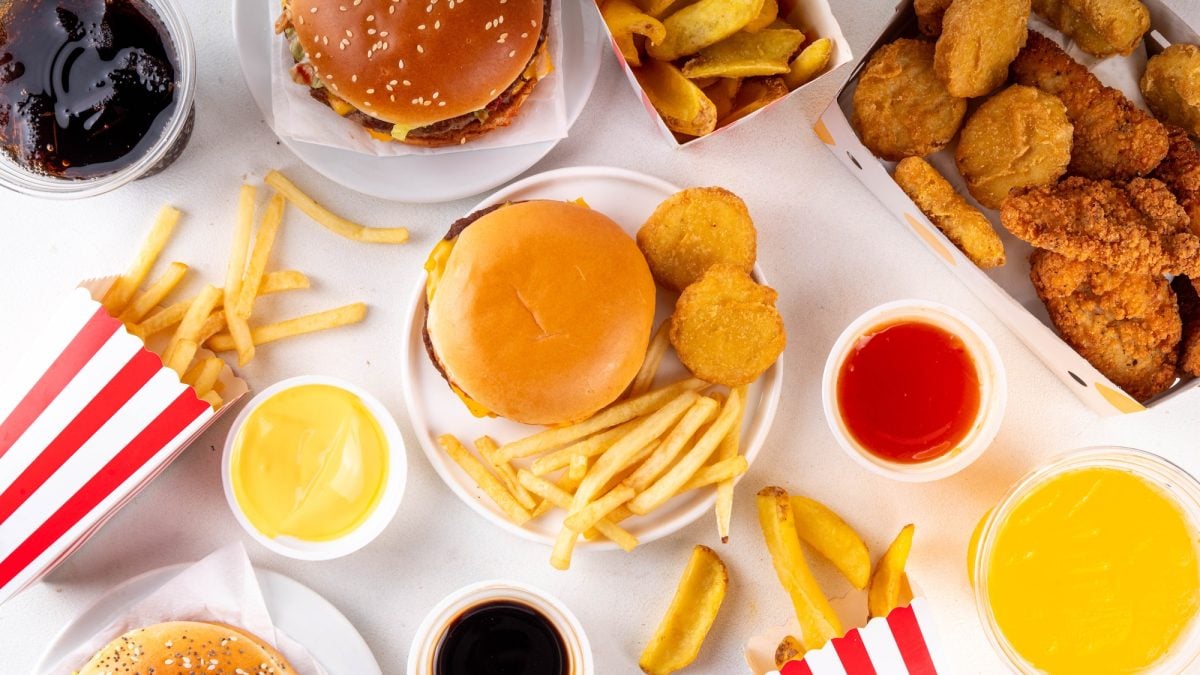
Despite their proven harmful effects, ultra-processed foods (such as ready meals, fast food dishes, soft drinks, etc.) represent nearly a third of our daily caloric intake. A team of researchers sought to find out how many minutes of life each of them could cause us to lose. Their alarming results were presented at the last annual meeting of theAmerican Society for Nutrition.
The food that wastes us the most time is…
Nearly 540,000 people aged 50 to 71 participated in this study which began in 1995. For more than 25 years, researchers sought to understand the link between what they ate (5,800 foods screened) and the illnesses they reported, or even which caused their deaths.
Two subcategories of ultra-processed foods have attracted the attention of researchers:
- Meats when they are highly processed;
- Soft drinks.
According to their calculations, cold cuts like prosciutto could cost you 24 minutes of life. Cheeseburgers, 9 minutes and bacon 6 minutes. But the prize for the most “deadly” food would go to the hot dog, bad because of its 61 grams of processed meat, which would lead to the loss of 27 minutes of life. When you add the sodium and fatty acids in this quick dish, that number jumps to 36 minutes. And even more if you pair it with a soda (which costs an extra 12 minutes)!
These foods that do us good
Rest assured, however. Other foods such as certain types of fish can, on the other hand, save us minutes of life. But against all odds, the peanut butter and jam sandwich (the famous American “peanut butter and jelly sandwich”) would be very good for your health (32 minutes more life). Next, at the top of the ranking, are nuts and seeds (24 minutes) then fruits (10 minutes).
“The urgency for dietary changes to improve human health is clear. Our results demonstrate that small, targeted substitutions offer a feasible and powerful strategy to achieve significant health and environmental benefits without requiring radical dietary changes.”the authors conclude.
Stay reasonable with this type of product
As a reminder, nearly 75% of foods consumed in the United States are considered ultra-processed and full of potentially harmful additives and ingredients. In France, Inserm also regularly reminds us that ultra-processed foods are particularly harmful to health:
“Many of them have low nutritional quality: they are often products not only rich in salt, sugars and/or saturated fats, but also poor in fiber and vitamins.”
Finally, their composition also poses long-term threats: “IThey contain substances whose long-term impact on health is not yet well known: certain additives, by-products resulting from industrial processing stages, contaminants that come from their packaging…”.