
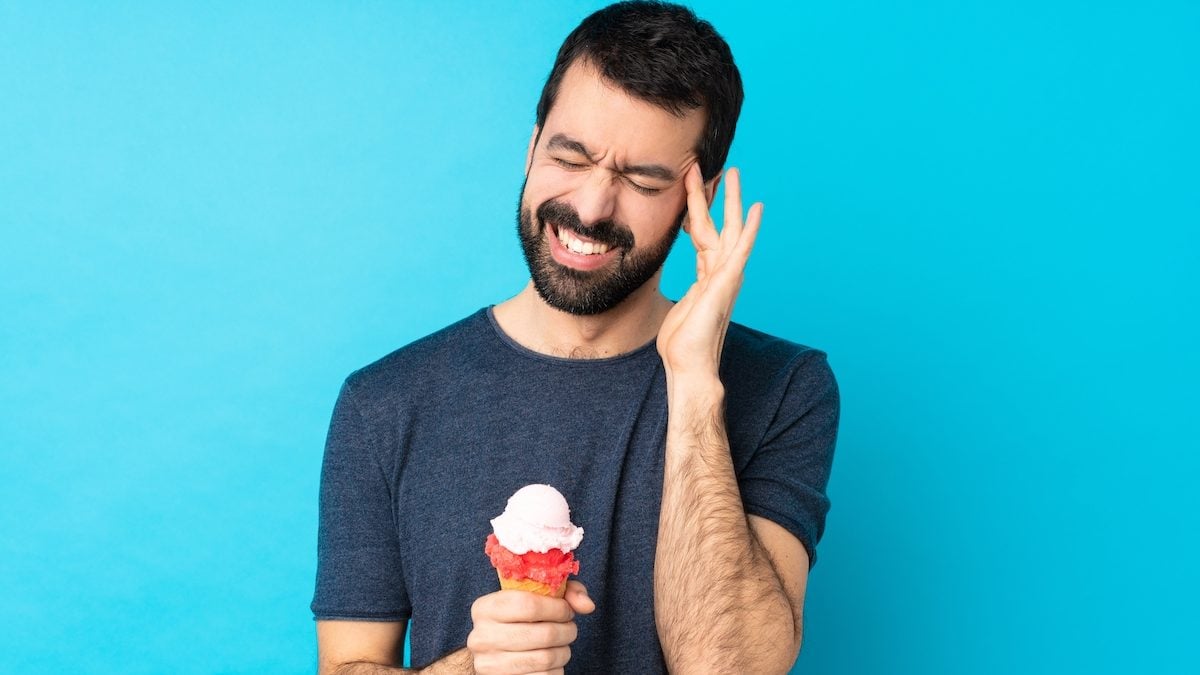
A little glossy pleasure that turns to grimace. You savor ice on the terrace, and suddenly, dazzling pain pierces your forehead. This phenomenon as brutal as “strange has a scientific name: the” headache of ice cream “. Unlike conventional migraines, this particular headache is neither rare nor disturbing, but it can spoil the best gourmet breaks.
What is the headache of ice cream?
Also known as “Brain Freeze”, this type of headache occurs after a sudden exposure to intense cold. This can happen in winter, underwater, or in a cryotherapy cabin. But it is especially in contact with frozen foods or drinks that the phenomenon is manifested, often spectacularly. Sometimes a spoonful of sorbet is enough to trigger this pain as sudden as brief. It is this peculiarity that earned him the nickname “headache of ice cream”.
According to the International Headache Society, this disorder is common in the general population and more frequently affects people prone to migraines. A study conducted in Taiwan on 9,000 adolescents reveals that around 40 % of them have already felt this pain in contact with a cold food, with an incidence on average 15 % higher in migrainers.
How does this pain manifest itself and why?
The symptoms are clearly identified: very acute pain located in the forehead or temples, but which only lasts a few seconds. “”These cold -caused headaches are generally very acute with front or temporal but relatively brief pain“, Specifies Dr Anne Donnet, a neurologist at the Timone hospital in Marseille. They are classified among the so -called situational headaches, like those caused by cough, physical effort or sexual intercourse.
The exact causes of this dazzling pain are not yet completely elucidated. However, all specialists agree that a thermal stimulus is at the origin of the mechanism. In case of ingestion of a food or an ice drink, the cold comes into contact with the palate. During a cold air inhalation, it acts on the pharynx. “”The mechanisms that follow remain under discussion. However, it seems that there are two types of ice -related headache with two different hypotheses“Explains Dr. Donnet.
The first form, which represents almost 80 % of cases, begins very quickly after ingestion – on average 12.5 seconds – and lasts about twenty seconds. It would be triggered by stimulating the palace sensory receptors, which transmit an alert via the Trijumeau nerve, responsible for facial pain. The second, rarer, appears more slowly (about 102 seconds after contact with the cold) and can last up to four minutes. This time, the pain would be linked to a vasospasm, that is to say a narrowing of the brain arteries reducing the oxygenation of the brain.
How to avoid having a headache while eating ice cream?
Should we worry? Not really. The “Brain Freeze” is impressive but safe. It is a transient and benign phenomenon. For those sensitive to it, some simple precautions may be enough to avoid it.
Here is how to limit the risk of chopped ice cream:
- Eat slowly, in small bites;
- Prevent the icy food from touching your palate directly;
- Favor cold drinks at moderate temperature;
- Breathe through the nose to temper the cold air;
- Reheat the palate with the tongue if the pain occurs. Do not need to give up ice. It only takes a little patience and method so that this summer pleasure no longer turns to the headache.