
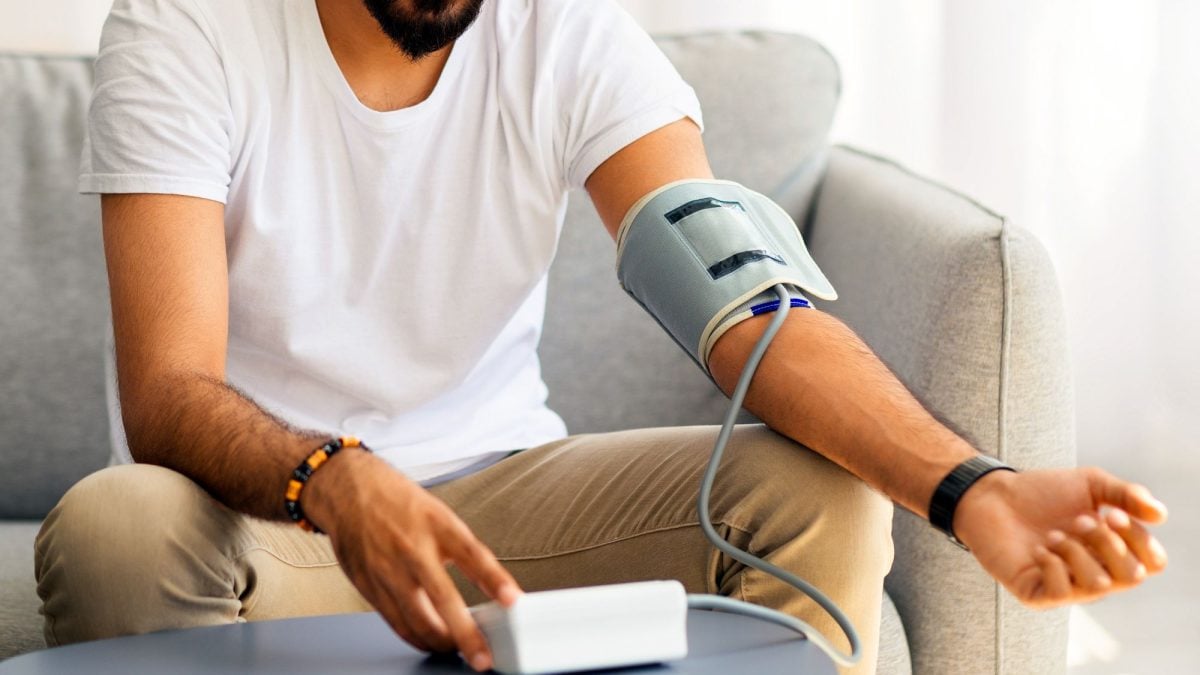
A misplaced arm, a coffee swallowed in a hurry just before… Be careful, certain gestures can distort the measurement of your blood pressure. Dr. Gérald Kierzek, emergency physician and medical director of True Medical, lists the errors frequently made, and helps you obtain accurate results.
High blood pressure, a common pathology
High blood pressure affects 14 million people in France, half of whom are unaware of their condition. Hypertension corresponds to a lasting rise in blood pressure beyond 14/9 (i.e. 140/90mmHg), while an ideal pressure is around 12/8 (120/80mmHg). But before making a definitive diagnosis, the doctor will measure his patient’s blood pressure during the consultation and not only that. In fact, blood pressure varies naturally during the day, so several measures are necessary: at rest, lying down and over two consultations spaced at least fifteen days apart.
For some individuals, simply seeing a doctor can cause stress and cause a temporary increase in blood pressure, a phenomenon known as “white coat syndrome” or “white coat hypertension.” To avoid this, your healthcare professional may ask you to take regular measurements of your blood pressure, two or three times a day. How to achieve reliable results? Dr Gérald Kierzek, emergency doctor and medical director of True Medical, tells you the mistakes to avoid.
Bad arm position
“Avoid placing your arm on your knee, as this position distorts the measurement: the arm is too low in relation to the heart“, warns Dr. Kierzek. The golden rule is simple: “arm placed on a table, cuff at heart level, palm facing upwards.”
This common error can cause numbers to be higher or lower than reality, masking high blood pressure or causing a false alarm.
Measurement just after an activity or a coffee
Tension is extremely sensitive to context: it varies depending on stress, physical effort, or even a simple coffee.
“You must avoid any physical activity, coffee, tobacco or stress in the preceding 30 minutes”says the doctor.
Before any measurement, sit quietly and wait five minutes. This delay may seem trivial, but it is what allows you to obtain a result representative of your actual state.
A poorly used cuff
A cuff that is too loose, poorly positioned or poorly adjusted can completely disrupt the measurement. “For arm models, it should be placed 2 cm above the elbow crease“, insists the doctor. And for wrist blood pressure monitors, even more capricious: “the wrist must be aligned precisely with the heart, otherwise the values will be erroneous.”
It is also important to choose a validated device, with CE marking, and ideally present on the ANSM list of approved devices. “We prefer blood pressure monitors with arm cuffs, except for portable use, strictly respecting the instructions”he specifies.
Take a single measurement
Measuring your blood pressure once, by the way, has no medical benefit. “It is necessary to take three consecutive measurements, spaced 1 to 2 minutes apart, in the morning and evening, for 3 to 7 days.recommends Dr. Kierzek.
Why so many precautions? Because blood pressure fluctuates throughout the day. “It is essential to calculate the average of the results, and to systematically note the values”whether in a notebook or a mobile application.
A concrete example of good practice according to the doctor: “Three consecutive measurements in the morning before breakfast, arm relaxed at heart height, after five minutes of rest.
Ignoring the impact of meals or alcohol
Meals and especially alcohol directly influence blood pressure. “Alcohol promotes dehydration and vasodilation, which disrupts the numbers“, explains Dr. Kierzek. It is therefore recommended to measure your blood pressure on an empty stomach in the morning, or two hours after a meal.
In the event of a value greater than 135/85 mmHg in self-measurement, it is important to show your readings to your doctor.