
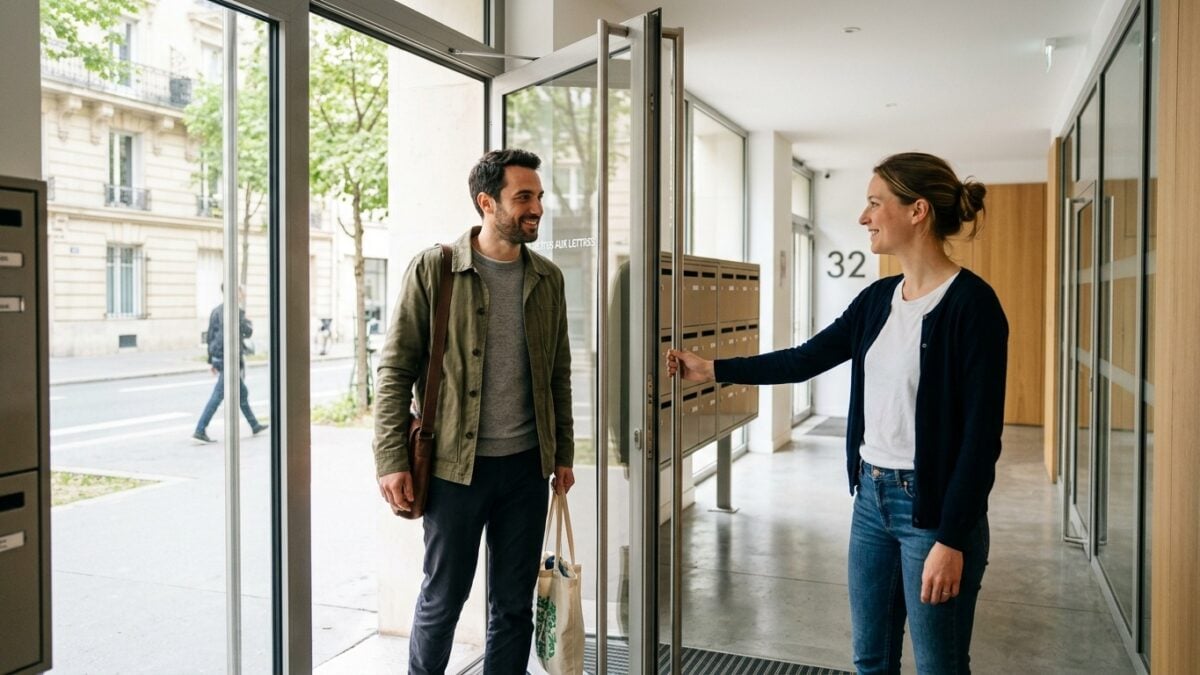
In the building, in the office or in the supermarket, there is always that person who stays for a few seconds to hold the door for a stranger. She gauges the distance, blocks the door, gives a smile, sometimes mercilessly in return. A seemingly banal, almost automatic gesture. For psychology, this discreet reflex nevertheless says a lot about personality.
Researchers are talking here about prosocial behavior: voluntary action to make life a little easier for others. The vast international study The Kindness Testcarried out on around 60,000 people in 144 countries, shows that the most common acts of kindness are precisely these micro-helps, such as holding a door. Those who multiply them also report greater well-being. It remains to be understood which rare traits support this reflex.
Psychology: What Holding the Door for Strangers Reveals
For specialists, repeating this gesture is not just a question of politeness. This often reflects a strong sense of personal responsibility, what psychologists call an internal locus of control: the idea that we can act, even on a small scale, on the atmosphere around us. Holding the door then becomes a concrete way of taking care of the shared space and the social climate.
Research conducted at the University of California associates these repeated acts of kindness with increased morale and less perceived stress. Especially when the motivation comes from yourself, without expectation of thanks. In those who systematically hold the door, psychology finds a bundle of qualities: empathy, patience, sense of observation, desire for connection, proactivity and non-transactional kindness. Taken together, these are surprisingly rare traits.
The rare traits of people who always hold the door
Concretely, these people very quickly notice what is happening around them. They see the arms full, the gait slowed down, and adjust their behavior. This attention to others is accompanied by an ability to put oneself in their place: it is not just feeling, it is acting accordingly. Many also appreciate the little interaction that goes with it, this brief exchange of looks or smiles that creates a bond.
There is also this patience of enduring a few seconds of waiting without sighing or feeling wronged. This tolerance to micro-constraint shows that the small annoyance does not take up all the space. These people act proactively, anticipating the need before it is formulated. Observations on campuses finally indicate that those who benefit from a held door are then more likely to repeat this gesture.
A mirror of oneself to tame without pressure
Holding the door is a common courtesy gesture in daily life, which depends above all on habits and social context. These repeated micro-gestures shape a certain self-portrait and influence the surrounding atmosphere. Looking at how you practice them, according to your current energy, already says a lot about the space you leave for others.