
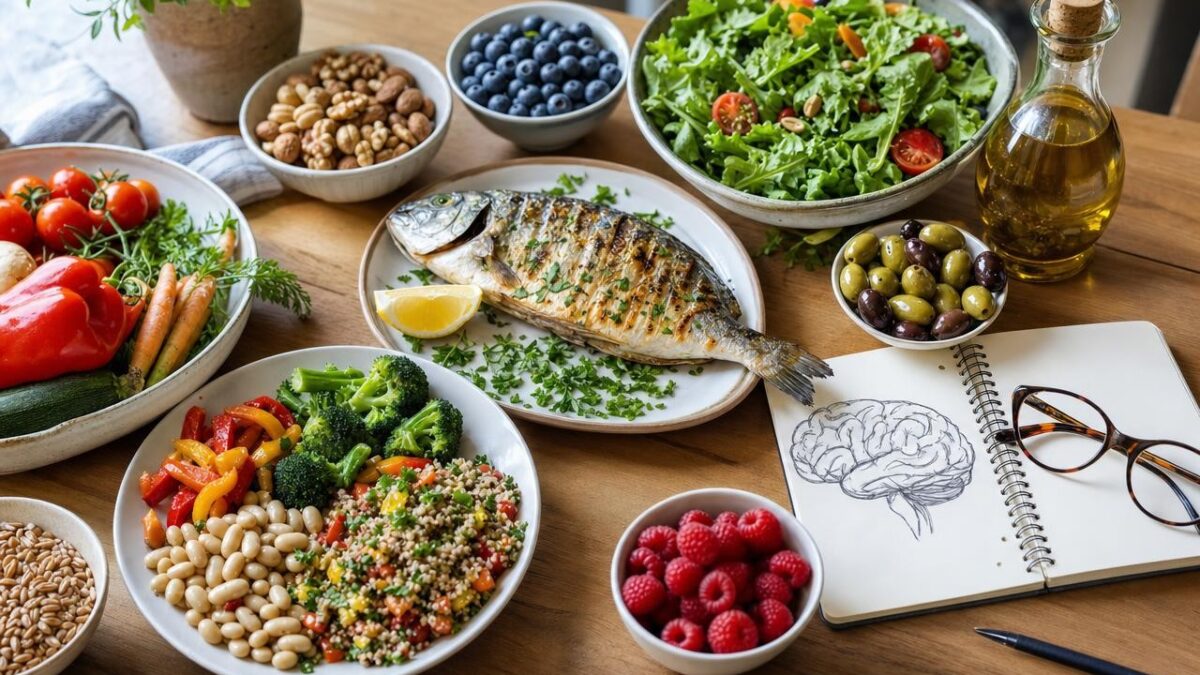
The American authority responsible for dietary guidelines, the Dietary Guidelines Advisory Committee (DGAC), concluded in 2025 that there was not enough data to recommend a specific diet for cognitive decline. A Euro-American team has just re-examined the question in the Journal of Nutrition : by bringing together the individual data of 17,368 adults followed in eight cohorts, she observes that certain
diets are linked to better
cognitive performance.
The models that stand out the most are the
Mediterranean diet rated as a continuous score, the
DASH diet and the
MIND dieta hybrid of the two designed for the brain. Better adherence to these patterns is accompanied by better memory and executive function scores, while high consumption of red and processed meat goes in the opposite direction, a major issue in a world where 57 million people live with dementia.
What the study shows about the Mediterranean, DASH and MIND diets
Led by Natalia Soldevila-Domenech and supported by the Institute for the Advancement of Food and Nutrition Sciences (IAFNS), the team carried out a meta-analysis of individual data (IPD) from eight studies in Europe and the United States, with harmonized dietary questionnaires and two key tests: Mini-Mental State Examination for global cognition and Trail Making Test Part B for executive function. The analyzes were adjusted for age, education, smoking and diabetes.
The authors summarize: “In this harmonized individual data meta-analysis, adherence to the continuous MedDiet, DASH, and MIND diets was associated with better cognitive performance in cross-sectional analysis, but not over time“. The differences remain modest on an individual scale, but robust when we consider all 17,368 participants from the Framingham cohorts and other large studies.
Real cognitive benefits, but limited in time
On the follow-up, only the MIND dietevaluated in three American cohorts, was linked to a slightly more favorable executive function trajectory. The effect remained small, of the order of a few hundredths of a second saved per year in the TMT-B test. Conversely, higher consumption of red and processed meat was associated with poorer executive performance in cross-sectional analysis.
The authors conclude that “findings suggest that diet quality can support cognitive health but likely needs to be integrated with broader lifestyle improvements for significant long-term benefits“. In other words, these diets alone do not prove prevention of dementia, which already affects around 57 million people and 10 million new cases each year.
How to draw inspiration from the MIND, DASH and Mediterranean diets in your daily life
The three diets share a simple foundation: lots of vegetables, fruits, legumes, whole grains, nuts, fish and oils rich in unsaturated fatty acids, little red or processed meats and sugary drinks. The study suggests that such a dietary profile goes hand in hand with a slightly sharper brain, provided it is part of an active lifestyle, with preserved sleep and cardiovascular health.