
Published on October 7, 2026 in the New England Journal of Medicinethe results of a trial carried out on ten patients explore a new approach: making retinal cells still intact sensitive to light, despite the destruction of photoreceptors.
A new approach to a disease that leads to blindness
Retinitis pigmentosa can gradually disrupt everyday life: night vision diminishes, the visual field narrows and movement becomes increasingly difficult. In advanced forms, the disease can lead to blindness.
It affects more than 1.5 million people worldwide and represents a major therapeutic challenge. The cause: mutations in more than 100 different genes, which complicate the development of treatments adapted to each patient.
“Retinitis pigmentosa can result from a mutation in any of more than 100 distinct genes, making it an extraordinary challenge.”explains José-Alain Sahel, director of the UPMC Vision Institute, in a press release from the University of Pittsburgh published on October 7, 2026.
To get around this obstacle, researchers explored optogenetics, a technique which consists of making certain cells sensitive to light. The goal is not to repair the destroyed cells, but to allow those that remain to transmit visual information again.
An injection and glasses to stimulate the retina
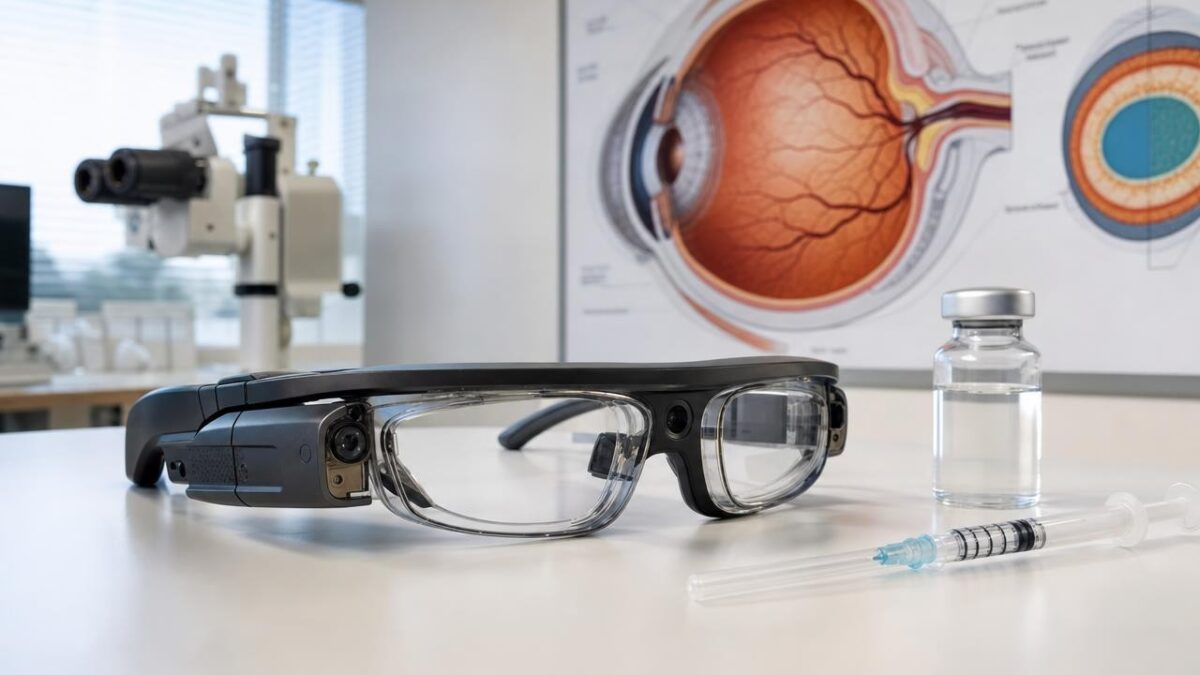
In the PIONEER clinical trial, ten adults with advanced retinitis pigmentosa who were nearly or completely blind received an injection into the more affected eye. This contained a viral vector carrying the gene allowing the production of the photosensitive protein ChrimsonR.
This protein makes the remaining retinal ganglion cells sensitive to a specific wavelength. Glasses equipped with a camera then capture the environment and convert it into suitable light patterns, projected onto the treated retina.
These stimulations activate the modified cells, which can transmit signals to the brain. The technique thus partially circumvents the loss of photoreceptors responsible for vision.
However, the device does not restore natural vision. It produces a simplified perception, the usefulness of which depends in particular on the patient’s ability to learn to interpret light information.
Seven out of ten patients improve their sensitivity to light
The results, published in the New England Journal of Medicineare encouraging. Seven of ten participants improved their sensitivity to lightand six recorded progress deemed clinically significant on the FST test, which measures the lowest perceptible light level.
With the glasses, some patients were also able to better detect the presence of an object, locate it and reach out towards it with more precision. Electroencephalography tests confirmed that visual signals reached the visual cortex, the brain region responsible for processing this information.
Four participants showed consistent improvements in several visual tasks over months to years of assessment.
“These results show that even in people with profound vision loss, the visual system retains a remarkable capacity to process new information.underlines José-Alain Sahel, cited in the press release from the University of Pittsburgh of October 7, 2026.
The limitations nevertheless remain significant: patients cannot read or recognize faces using the device. The vision obtained remains very simplified, close to a monochrome perception. Progress also seemed greater among participants who trained the longest with the glasses.
A hope to be confirmed for blind people
The safety of the treatment is another essential point. Researchers identified 34 ocular side effects, mostly mild or moderate, including temporary inflammation and transient increases in pressure in the eye. A severe but transient episode has also been reported, before resolving within a few minutes after administration of Iopidine.
With only ten participants, this early trial does not, however, allow us to definitively conclude on the effectiveness and safety of the treatment on a larger scale.
This research extends a first study published in 2021 in
Nature Medicinewho described partial visual recovery in a patient treated with optogenetics.
Ultimately, this approach could be of interest to other diseases causing blindness when certain cells of the retina remain functional. But this possibility still needs to be explored.
For patients, the issue goes beyond just measuring light sensitivity: better locating an object or understanding its position could represent concrete progress towards greater autonomy. Restored vision remains limited, but these results show that profound visual loss does not necessarily mean that all visual information processing ability is gone.