
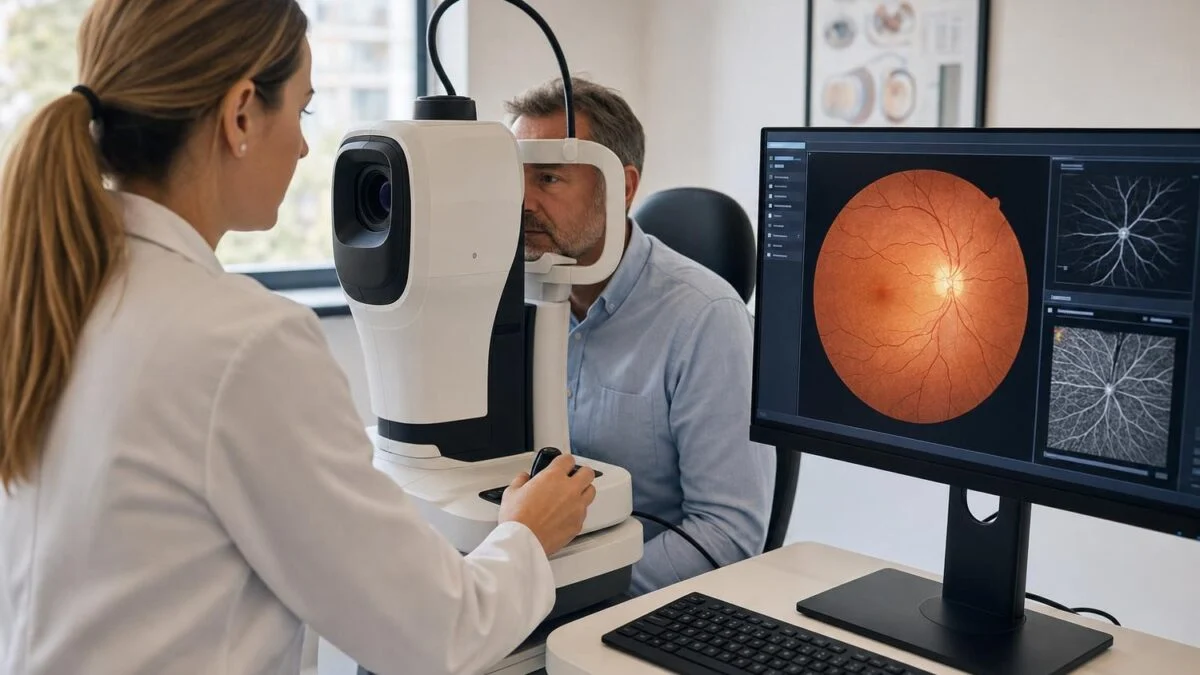
For years, the eye has been considered a window to the world. It could soon also become a window into our bodies.
A fundus image, taken in a few seconds with a specialized camera, could tomorrow make it possible to identify sometimes silent chronic diseases, even before the first symptoms appear. A potential revolution for millions of people who are still unaware that they are affected.
When the eye becomes the silent mirror of our health
The principle is based on a fascinating idea: the retina is not only a tissue linked to vision. It could also reflect the general state of the body.
At the back of the eye there are tiny, directly observable blood vessels circulating. However, these structures can be modified by certain diseases such as diabetes or hypertension. But artificial intelligence goes further: it learns to spot combinations of extremely subtle signals, sometimes imperceptible to the specialists themselves.
Developed by an international team led by Xiayin Zhang, with participation from the Center for Eye Research Australia and epidemiologist Lisa Zhuoting Zhu, the technology is called “oculomics”, an approach that involves using information in the eye to understand what is happening elsewhere in the body.
With Reti-Pioneer, the AI was trained to analyze traces associated with six metabolic or endocrine conditions : type 2 diabetes, hypertension, hyperlipidemia, gout, osteoporosis and thyroid disease.
To learn, the system studied an immense volume of data: 107,730 retinal images from 53,865 volunteersoriginating in particular from the British UK Biobank cohort and several Chinese hospital establishments.
Behind this technological feat, the challenge is above all human: detect earlier, to act more quickly.
Reti-Pioneer: screening for 6 diseases in less than 30 seconds
In the real conditions tested in 2025, Reti-Pioneer delivered an average result after 30.6 seconds per person. For comparison, the traditional medical pathway is often based on a blood test, followed by transport of the sample, laboratory analysis and then feedback to the patient. In the study, this process required nearly eight hours.
A difference which could become decisive in certain remote regions. “This technology will bring real benefit to public health. Patients could get information about their health instantly and start interventions as soon as possible instead of waiting for longer test results.”explains Lisa Zhuoting Zhu, one of the main authors of the study.
Interest is particularly important for territories where medical laboratories are remote. A consultation with a general practitioner, a visit to an optician or a mobile screening campaign could tomorrow integrate this type of analysis. With this time saved, treatment is received earlier and complications are more easily prevented.
A powerful AI, but caution remains essential
The results are promising, but the researchers emphasize one essential point: Reti-Pioneer is not a definitive diagnostic tool. It is a system of
triagecapable of identifying people who may need additional tests.
In a pilot study devoted to type 2 diabetes, the tool obtained better performance than a traditional risk assessment questionnaire, the FINDRISC, with a negative predictive value of 96.6%. In other words, when he judges that a person is probably not affected, he is rarely wrong.
To measure its robustness, the researchers also tested the system on 23,232 images from 11,616 people in Chinain different care settings, as well as in the multi-ethnic Singapore Epidemiology of Eye Diseases cohort.
Another advantage: Reti-Pioneer works with a classic fundus camera, without requiring particularly complex equipment. A feature that could facilitate its deployment in medical offices, pharmacies or mobile units.
Towards a medicine that is closer, faster, more accessible?
Artificial intelligence will not replace the doctor’s perspective. But it could profoundly change the way certain diseases are identified. Today, many chronic pathologies develop quietly for a long time. Type 2 diabetes, hypertension or certain metabolic disorders can progress for years before being diagnosed.
The ambition of technologies like Reti-Pioneer is therefore less to predict the future than to avoid delays in support.
“Artificial intelligence platforms like this can significantly improve access to care, particularly for populations living in regional and remote communities.”
The next step will now be to confirm these results on a larger scale, in different health systems, and to define how to integrate these tools into daily practice. Maybe one day it will be enough to look at one eye to better care for the whole body.